2025.12
03
What Does “BY” Mean on a Sake Label? Understanding the Brewery Year in Japanese Sake
Have you ever seen the notation “〇〇BY” on a sake label? For example, “2020BY” or “30BY”—a number followed by “BY.” This small detail actually reveals a lot about the sake itself. Even if the name of the sake is the same, a different BY number can mean a noticeable difference in flavor. In this article, we’ll take a closer look at what “BY” stands for, how to read it, and how you can use it to better enjoy and choose your sake.
BY Represents the Brewing Year of the Sake
“BY” stands for “Brewery/Brewing Year,” which indicates the brewing year (醸造年度 / 酒造年度) of the sake. In the sake industry, one brewing year runs from July 1 to June 30 of the following year. The notation combines the brewing year with “BY.” For example, if a sake was brewed in January 2021, it would be labeled as “2020BY.”
the name of the current emperor’s reign instead of Western years. For example:
- Reiwa 2 BY corresponds to 2020BY,
- Reiwa 3 BY corresponds to 2021BY, and so on.
Older labels may use Heisei or Showa years—for instance, Heisei 30 BY means 2018BY in the Western calendar.
Originally, this system was established under Japan’s Liquor Tax Law to accurately track annual production volumes. Traditionally, sake brewing took place between autumn and early spring—after the rice harvest in October—so the brewing year used to run from October 1 to September 30. However, with advances in brewing technology and the availability of early-harvest rice, many breweries began brewing earlier in the year. As a result, in 1965 (Showa 40), the official brewing year was redefined to span from July 1 to June 30.
October 1 Is “Sake Day,” a Legacy of the Old Brewing Year
As a side note, October 1 has been designated as “Sake Day” by the Japan Sake Brewers Association since 1978, to promote the appreciation and cultural preservation of sake. The choice of this date stems from the fact that the brewing year originally began on October 1. Even today, various sake-related events are held nationwide on this day—showing how the legacy of the old brewing calendar remains cherished among sake lovers.
Rules for BY Label Display
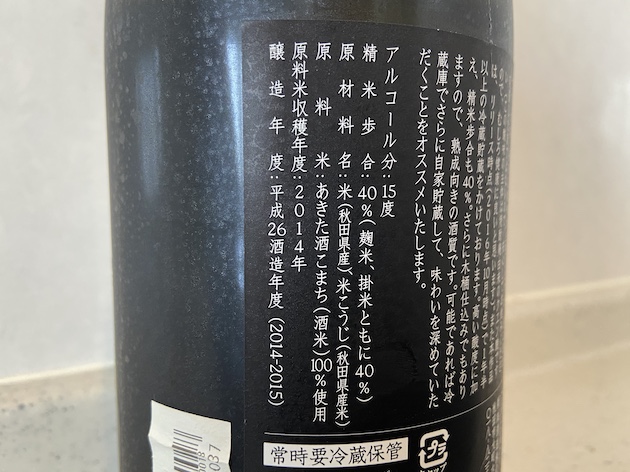
There are a few key points to understand when reading BY labels. Knowing these will help you interpret the information correctly.
1. Displaying BY Is Not Mandatory
Labeling sake with a BY is not legally required. Until recently, it was relatively rare to see BY indicated on labels. One reason is that, for a long time, “fresh sake is better” was the prevailing belief—aged or matured sake (koshu) was not widely appreciated, and most sake was consumed within about a year of brewing. However, influenced by wine culture and changing consumer tastes, the appeal of aging has been rediscovered, and more breweries now display BY on their labels.
2. Blended Sake Does Not Indicate BY
When a sake is a blend of different brewing years, the BY is not displayed. However, if the label mentions the aging period (e.g., “aged for one year”), it must reflect the most recent brewing year among the blended components. For example, if in 2020 a brewery blends sakes from 2016–2019, the product may be described as “aged for one year.” In practice, though, it’s uncommon to indicate the aging period for such blends.
3. The Brewing Year Is Not the Same as the Bottling Date
BY refers to the year in which the moromi was pressed to produce sake— If the sake was aged in tanks after pressing, the BY (pressing year) and the manufacture date (bottling date) could differ. Reading both can offer fascinating insight into the production timeline and maturation process of the sake.
For more about how manufacturing dates are indicated on sake labels, see the following article.How to Enjoy BY Labels
Now that you understand what the BY label means and how it works, let’s look at how you can use that information to deepen your enjoyment of sake.
Seek Out Vintage Sake

While vintage sake is still far less common than vintage wine, the number of aged sakes (koshu, jukusei-shu) has been steadily increasing in recent years. The BY label tells you exactly when the sake was brewed, so you might come across bottles with a bit of history behind them.
Vintage sakes tend to have a richer, more complex flavor, often becoming smoother and more rounded as they mature. Their once-sharp edges soften over time, resulting in a deep, harmonious taste experience.
Although long-aged sakes are still relatively rare, younger drinkers might even be able to find a bottle brewed in their birth year—a wonderful and meaningful way to celebrate a special occasion. If you haven’t yet tried an aged sake, why not give it a try?
Enjoy Choosing Sake Through BY Labels
In this article, we’ve explored the meaning of BY (Brewing Year), how it’s displayed on labels, and ways to enjoy it when choosing sake. We hope it has helped clear up some of your questions about BY labels.
By understanding the BY, you can not only learn when a sake was brewed, but also get a sense of the brewer’s philosophy, the year’s climate, and the history behind the bottle. Even the same brand can taste different depending on the brewing year, making side-by-side comparisons a fascinating experience.
Let the BY label be your guide to discovering new stories and flavors hidden in each bottle of sake—and to enjoying the depth and diversity that Japanese sake has to offer.
Pickup Articles


2019.01.18

2019.01.25
Trending Articles


Popular Articles
Recent Articles