2026.01
28
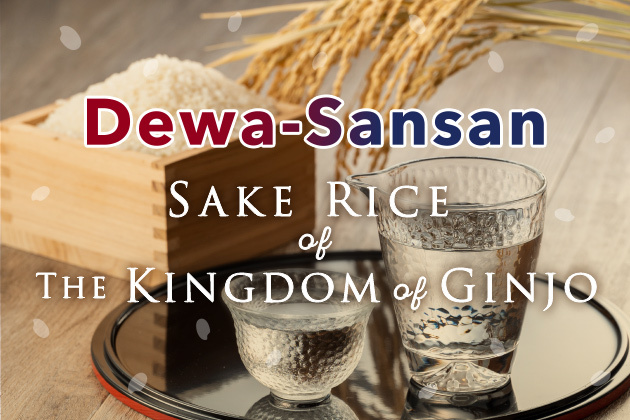
Genealogy of Dewa Sansan: Sake Rice that Supports Yamagata, the Kingdom of Ginjo
Yamagata Prefecture is often referred to as the Kingdom of Ginjo, reflecting the fact that ginjo-style sake accounts for a higher proportion of total production here than in any other prefecture.
Known for its clarity and elegant, floral aromatics, Yamagata’s “ginjo” sake has earned the affection of many drinkers. One rice that has long supported this regional style is Dewa Sansan, the sake rice at the heart of this article.
Here, we take a closer look at how Dewa Sansan came into being, how it helped shape Yamagata’s “ginjo” culture, and why it continues to play such an important role today.
What is Dewa Sansan?
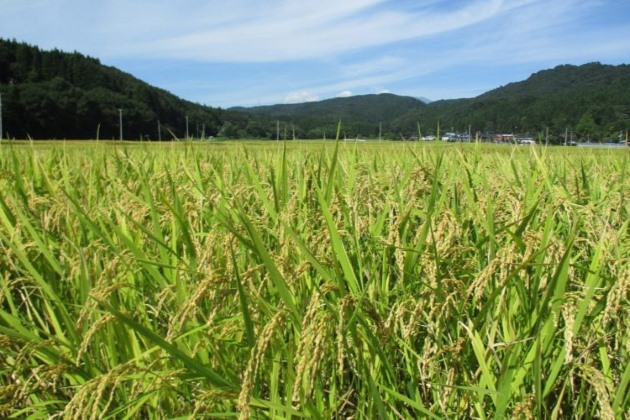
Yamagata has a long history of rice research, often traced back to agricultural policy in the Shonai Domain during the Edo period. That tradition continues today, with the prefecture cultivating a wide range of sake rice varieties—second only to Hyogo—and remaining actively involved in developing new rice strains.
Among these, Dewa Sansan stands out as one of Yamagata’s representative sake rices. Development began in 1985, through a collaboration between the prefecture, the Sake Brewers Association, and JA (Japan Agricultural Cooperatives).
Brewers value Dewa Sansan for many of the qualities expected of premium sake rice. Its grains are relatively large, it forms shinpaku reliably, and its protein levels tend to be low. Many also note how well it absorbs water during steaming, a trait that supports stable fermentation and smooth brewing operations.
Soft and highly soluble, the rice offers a broad expressive range, which is why it remains a favored choice among sake producers today.
From an agricultural standpoint, Dewa Sansan is also appreciated for its strong cold tolerance and its relatively low tendency of the stem bending over and falling to the ground. Thanks to these strengths, production has remained steady, and the variety consistently ranks among the top ten sake rice varieties in Japan by volume.
History of Dewa Sansan
Before Dewa Sansan was developed, Yamagata faced a shortage of brewing-grade rice, and many breweries relied heavily on table rice. To address this, the prefecture trialed Miyama-nishiki, a variety originally from Nagano, while working to refine cultivation techniques. Miyama-nishiki was eventually adopted as a recommended rice for Yamagata.
However, Miyama-nishiki also presented challenges. Its long stockmade it prone tobending, and its shinpaku expression varied significantly depending on the region and the year.
Farmers were looking for a rice that offered advantages in cultivation and economic return, while brewers wanted a Yamagata-grown variety with strong brewing characteristics. In response, the Shonai Branch of the Yamagata Prefectural Agricultural Experiment Station launched a new breeding program in 1985.
After six years of trials—including yield testing and evaluation as a recommended variety—Dewa Sansan began to distinguish itself from Miyama-nishiki. Compared with Miyama-nishiki, it showed the following characteristics:
- Medium growth, with heading and maturation occurring roughly two days later
- A stock length 5–6 cm shorter, still relatively long but far more resistant to slumping over
- A polished rice yield equivalent to 107% of Miyama-nishiki, indicating higher productivity
- A grain weight of 25–26 g per 1,000 kernels, about 1 gram larger than Miyama-nishiki
- Superior appearance quality and a higher rate of shinpaku expression
In 1991, the line was designated Yamagata Sake No. 49. When it was officially registered as a variety in 1997, it was given the name Dewa Sansan, reflecting the hope that “Dewa,” the historical name of the region, would shine brightly.
Through this process, Yamagata finally gained its long-awaited original sake rice—one capable of meeting the needs of both farmers and brewers.
Genealogy of Dewa Sansan
Dewa Sansan was bred from Miyama-nishiki as the mother and Aokei Sake No. 97,later named Hanafubuki as the father.
Miyama-nishiki, originally developed in Nagano Prefecture, is a mutation-derived variety created through radiation treatment of Takane-nishiki. Before the arrival of Dewa Sansan, it played a central role as a brewing rice in Yamagata.
Hanafubuki, developed in Aomori Prefecture in 1985, is known for its strong cold tolerance, short culm that resists lodging, and extremely large grains with a high rate of shinpaku formation.
About a decade later, Dewa Sansan was itself used in breeding. When crossed with Ginfubuki, a sake rice from Shiga Prefecture, it produced Dewa no Sato, a variety with enhanced cold tolerance. This addition further expanded Yamagata’s range of sake-brewing options.
Dewa Sansan is Grown Exclusively in Yamagata
Dewa Sansan is cultivated only in Yamagata Prefecture, where it was originally developed. While it is grown widely across the region as Yamagata’s signature sake rice, Kaneyama Town and Shinjo City are particularly well known as leading production areas.
Kaneyama Town
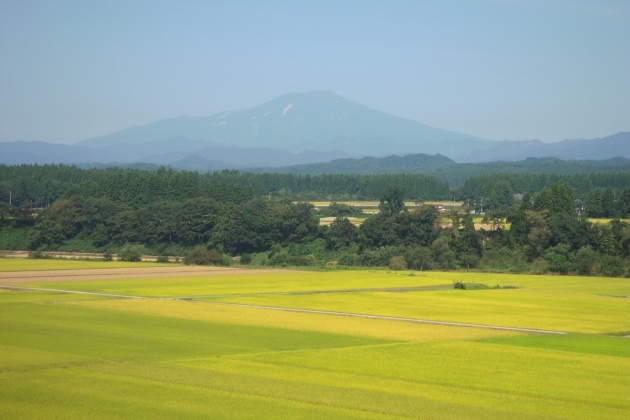
Located in northeastern Yamagata, Kaneyama Town promotes environmental stewardship through initiatives such as the Landscape Harmony Ordinance, aimed at preserving scenic beauty while supporting local industries.
Sake rice cultivation began here in 1986, and the town is now known as a “home of sake rice,” producing varieties such as Dewa Sansan. To strengthen market competitiveness, some producers have adopted contract-based cultivation and participate in certification programs, including GAP certification. This emphasis on quality management has helped build trust among breweries both inside and outside the prefecture.
Note: GAP (Good Agricultural Practices) is a private certification system in which third-party auditors evaluate a farmer’s production management practices.
Shinjo City
Shinjo City, also in northeastern Yamagata, is home to a sake rice research group known as Yubikiri Genman, dedicated to producing high-quality rice through advanced cultivation techniques. Inspired by the introduction of Dewa Sansan, two farmers began planting sake rice, and as production expanded, the group was formally established in 2009.
Shinjo has since earned strong recognition in the Excellent Sake Rice Contest hosted by the prefecture, receiving awards almost every year since 2014. Although it entered sake rice production later than many areas, Shinjo’s planted acreage has grown to rank first in Yamagata, raising expectations for further quality improvements in the future.
Production Volume and Share Within the Prefecture
In 2022, Dewa Sansan recorded a harvest of 1,313 tons, ranking sixth among all sake rice varieties produced in Japan that year.
Within Yamagata Prefecture, Dewa Sansan accounts for roughly 40% of sake rice production. When its descendant Dewa no Sato is included, the combined share rises to approximately 60%, underscoring the central role these cultivars play in the region.
More than thirty years after its debut, Dewa Sansan remains deeply valued as Yamagata’s signature sake rice, cherished by both brewers and sake fans.
“DEWA33” Designation
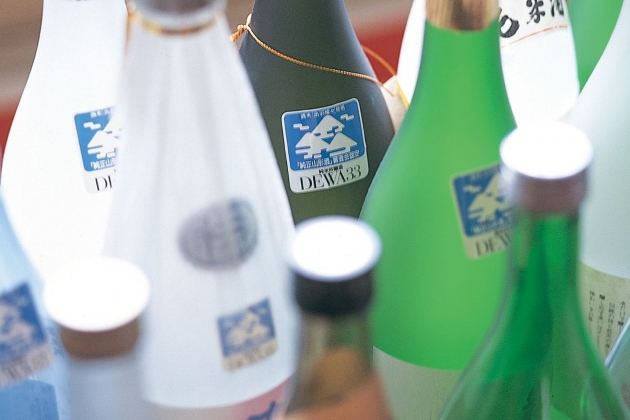
Alongside rice development, Yamagata also advanced research into yeast and koji molds, leading to the creation of Yamagata Yeast and Oryze Yamagata, a koji mold unique to the prefecture. Combined with locally grown rice and pure local water, these efforts laid the groundwork for brewing sake that is truly “All Yamagata.”
Today, Yamagata promotes a certification program that grants the DEWA33 designation, along with the Pure Yamagata Sake Certification, to sake that meets the following criteria:
- Made with 100% Dewa Sansan
- A junmai ginjo with a polishing ratio of 55% or lower
- Uses Yamagata Yeast and Oryze Yamagata
- Brewed with water sourced within the prefecture
The name DEWA33 draws on both “Dewa Sansan” and the number of mountains in the prefecture said to exceed 1,400 meters—33 in total—symbolizing the strong link between sake, landscape, and regional identity.
Summary
In this article, we have explored the origins, characteristics, and significance of Dewa Sansan, a long-awaited original sake rice developed by Yamagata Prefecture and still cherished today as one of its defining cultivars.
As reflected in the DEWA33 criteria, Yamagata places great emphasis on ginjo-style brewing. The aromas and flavors created through this “All-Yamagata” approach can be seen as a crystallization of the prefecture’s natural environment and accumulated craftsmanship.
Breweries across Yamagata continue to brew sake with Dewa Sansan. We invite you to experience these expressions for yourself—sake shaped by landscape, climate, and the quiet refinement of regional technique.
References
- Sakurada, Hiroshi, et al. Development of the New Sake Rice Variety “Yamagata Sake No. 49”. Bulletin of the Yamagata Prefectural Agricultural Experiment Station, No. 30, March 1996.
- Yuki, Kazuhiro, et al. Development of the New Sake Rice Variety “Dewa no Sato” (Yamagata Sake No. 86). Bulletin of the Yamagata Prefectural Agricultural Research Station, No. 38, March 2006.
- Ministry of Agriculture, Forestry and Fisheries (MAFF). Demand and Production Trends for the Top 30 High-Demand Sake Rice Varieties for the 2025 Growing Season.
- Ministry of Agriculture, Forestry and Fisheries (MAFF). Agricultural Inspection Results for Sake Rice (Production Volume) and Estimated Production Volume for 2022 by Variety and Production Area.
- Oishii Yamagata. All-Yamagata Sake Brewing: Team Yamagata and the GI Designation.
- Kaneyama Town. Kaneyama Town Council Bulletin. Issued November 4, 2022.
- JA Oishii Mogami, Hokubu Sake Rice Research Group. Yubikiri Genman: Aiming to Become the Home of Sake Rice Supporting “Yamagata Sake”.
- Soejima, Akiko. Sakamai Handbook, Revised Edition. Bunichi Sogo Shuppan, 2017.
Pickup Articles


2019.01.18

2019.01.25
Trending Articles


Popular Articles
Recent Articles