2026.02
04
What is Multiple Parallel Fermentation? The Unique Fermentation Method that Defines Sake
Sake, wine, and beer are all classified as fermented alcoholic beverages. While they differ in raw materials, an even more fundamental distinction lies in how alcohol fermentation itself unfolds.
Sake is made from rice and rice koji, and the fermentation system that supports it is known as multiple parallel fermentation. This approach, while closely associated with sake, is not entirely unique. Similar fermentation structures can be found in other traditional Asian alcoholic beverages, including shochu and awamori in Japan, Shaoxing wine in China, and makgeolli in Korea.
In this article, we explore what multiple parallel fermentation is, how it differs from the fermentation methods used in wine and beer, how it shapes flavor and structure, and how this distinctive system took form over the long history of sake.
- Comparing Fermentation Method
- How Does Multiple Parallel Fermentation Influence Flavor?
- The Evolution of Multiple Parallel Fermentation in the Long History of Sake
- From Kuchikami-zake to the Use of Koji
- Technological Innovations in Yeast Starter Production
- The Establishment of Winter Brewing (Kan-zukuri) and the Development of the Sake Industry
- Scientific Advancement and the Development of Brewing Technology
- Research and Development Expanding the Diversity of Sake
- Summary
- References
Comparing Fermentation Method
Alcoholic Fermentation in Wine and Beer
To better understand multiple parallel fermentation in sake, it is helpful to first look at the fermentation processes used in wine and beer.。
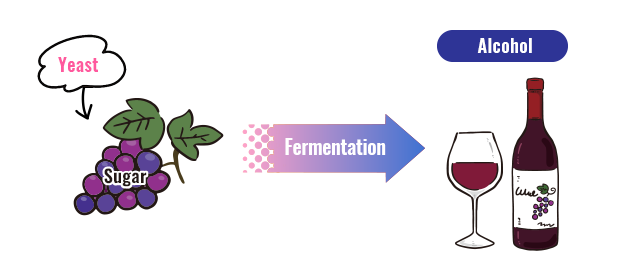
Wine is made from grapes, a raw material that already contains fermentable sugars. During alcoholic fermentation, yeast converts these sugars directly into ethanol. When fermentation proceeds in this straightforward way—without the need for prior sugar production—the process is referred to as single fermentation.
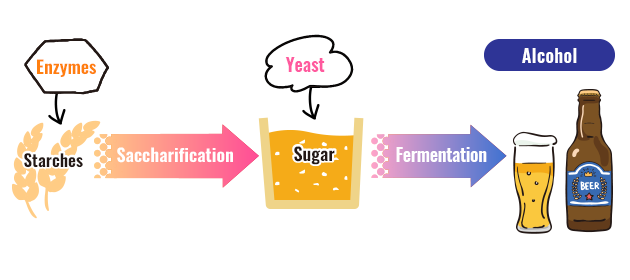
Beer follows a different path. In brewing, enzymes present in malt first act on barley, breaking down starches into sugars in a step known as saccharification. After this and several subsequent processes, yeast is added to the wort, and alcoholic fermentation begins.
When saccharification takes place first and alcoholic fermentation follows as a separate step, the process is known as multiple sequential fermentation.
Alcoholic Fermentation in Sake
What defines sake fermentation is the way saccharification and alcoholic fermentation proceed at the same time.
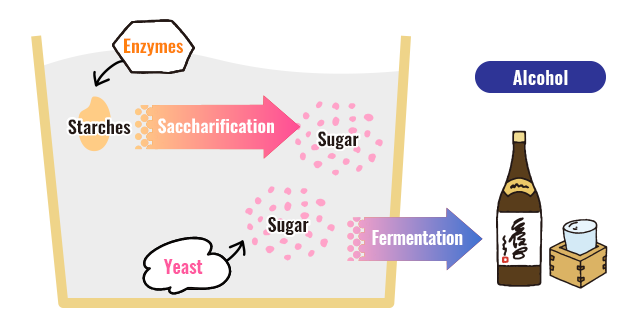
Rice, the primary raw material for sake, does not naturally contain fermentable sugars. Instead, the starch in the rice must be converted into sugar within the moromi (main fermentation). This conversion is carried out by rice koji.
Rice koji is produced by cultivating Aspergillus oryzae mold on steamed rice. During this process, key saccharifying enzymes are generated—most notably alpha-amylase and glucoamylase. Alpha-amylase first breaks starch down into water-soluble dextrins, which are then further decomposed by glucoamylase into glucose.
Yeast subsequently acts on this glucose, metabolizing it into alcohol and carbon dioxide through alcoholic fermentation.
Sake is brewed by combining kakemai (steamed rice), rice koji, a yeast starter (shubo or moto), and water in a single tank. Because saccharification by koji and alcoholic fermentation by yeast take place in parallel within the same vessel, this system is known as multiple parallel fermentation.
How Does Multiple Parallel Fermentation Influence Flavor?
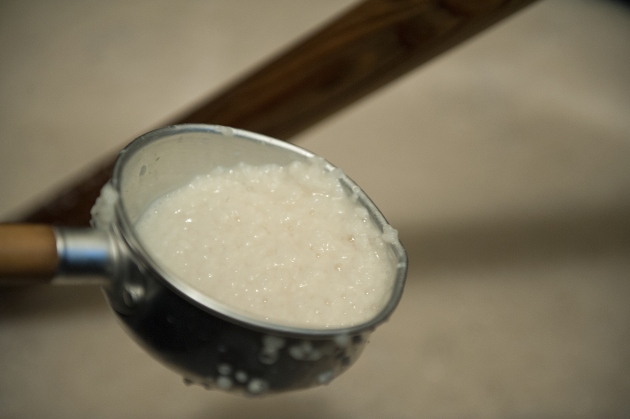
In multiple parallel fermentation, where saccharification and alcoholic fermentation advance side by side, factors such as temperature control and ingredient balance play a direct role in shaping flavor.
Temperature management, in particular, is central to regulating the activity of the microorganisms involved. For example, during tomezoe, the final stage of sandan-jikomi (three-stage fermentation), fermentation temperature is deliberately kept low to moderate yeast activity. Ideal temperatures are generally considered to be around 6–7 °C for ginjo-style sake and approximately 7–10 °C for futsushu. When temperatures rise above these ranges, the resulting sake tends to show higher acidity and a rougher, drier profile.
Sandan-jikomi refers to a method in which raw materials are added to the fermentation tank in three stages: hatsuzoe (first addition), nakazoe (second addition), and tomezoe (final addition).
Fermentation formulation also has a significant influence on flavor. Known as shikomi-hai, this formulation functions much like a recipe, determining the proportions of ingredients added at each stage of sandan-jikomi. Three ratios are especially important: the kumimizu-buai (water-to-rice ratio), koji-buai (koji ratio), and shubo-buai (yeast starter ratio). Together, these affect fermentation speed, aroma development, and overall sake character.
For example, increasing the kumimizu-buai—the proportion of brewing water relative to rice—reduces the inhibitory effects of excessively high sugar concentrations in the mash. As yeast activity becomes more vigorous, glucose in the moromi is metabolized more efficiently, resulting in a sake that is cleaner, crisper, and drier in profile.
The relationship between mash formulation, the balance of saccharification and fermentation, and resulting flavor tendencies can be summarized as follows:
| Balance Between Saccharification and Fermentation | Resulting Change in Flavor | |
|---|---|---|
| Increasing the kumimizu-buai (water-to-rice ratio) | Fermentation proceeds more rapidly | A lighter, cleaner, and drier style |
| Increasing the koji-buai (koji ratio) | Saccharification accelerates | A richer, fuller-bodied, and sweeter profile |
| Significantly increasing the shubo-buai (yeast starter ratio) | Fermentation in the early stage of the moromi becomes more vigorous | A richer, fuller-bodied, and sweeter style |
While many other factors also shape flavor—such as rice variety, polishing ratio, water hardness, and the characteristics of the yeast and koji used—the ability to fine-tune style and quality through temperature control, fermentation formulation, and careful management of saccharification and fermentation is a defining feature of sake brewed using multiple parallel fermentation.
The Evolution of Multiple Parallel Fermentation in the Long History of Sake
Although multiple parallel fermentation is central to what makes sake both distinctive and diverse, this system did not emerge fully formed. It took many centuries for the method to reach its present form.
From Kuchikami-zake to the Use of Koji
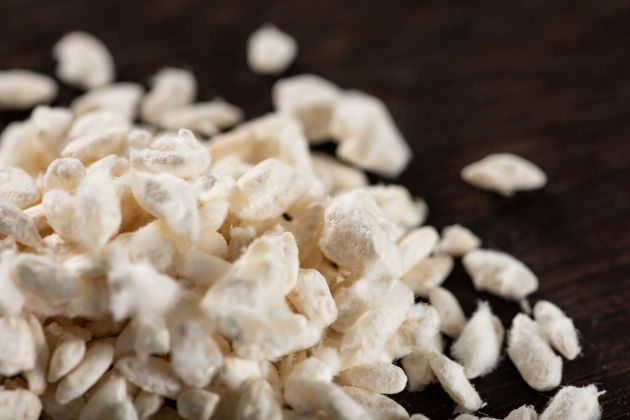
In ancient Japan, a form of alcoholic beverage known as kuchikami-zake was produced. This method involved chewing starchy plants such as grains or tubers and allowing the mixture of saliva and plant material to ferment. Similar techniques were practiced across regions from East Asia to the South Pacific and the Americas.
It is believed that this practice reached Japan during the late to final phases of the Jomon period (c. 1000–300 BCE), alongside slash-and-burn agriculture transmitted from Southeast Asia.
Later, during the Yayoi period (c. 300 BCE–300 CE), wet-rice cultivation was introduced from the Asian continent. With it came agricultural tools and ritual practices, among which one element would prove particularly significant for sake brewing: kikugetsu.
Kikugetsu refers to sprouted brown rice on which mold was cultivated. In China, alcoholic beverages made using this type of starter were already being produced. In Japan, production methods for getsu are described in the Engishiki (compiled in 927), a legal and administrative code of the Heian period. These records indicate that sake was brewed using tomokoji, a method in which naturally propagated koji was reused before the widespread adoption of modern tane-koji.
Seen in this light, the getsu of the Heian period can be understood as the direct precursor to modern koji. It was during this era that the structural foundations of sake brewing, recognizable even today, began to take shape.
Technological Innovations in Yeast Starter Production
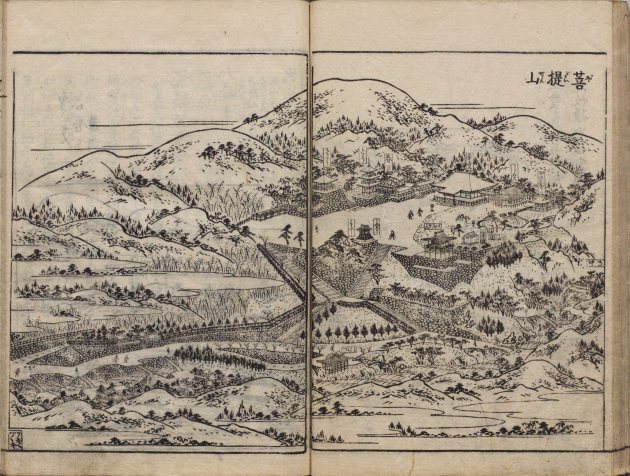
From the late 14th century—following the fall of the Kamakura shogunate (1333) and the end of the Nanboku-cho conflicts (1336–1392)—through to the close of the Sengoku period (c. 1467–1590), roughly two centuries saw the flourishing of soboshu, sake brewed by temples.
Originally produced for religious rites, temple-brewed sake gradually became a source of financial support for monastic institutions.
One notable example is Bodaisen, brewed at Shoryaku-ji Temple on Mount Bodai in Nara. This sake used soyashi-mizu, a lactic-acid-rich liquid cultivated with lactic acid bacteria and employed as brewing water. Bodaisen appears in the early Muromachi-period brewing manual Goshu no Nikki, where its production method is described in detail.
While initially consumed as sake, this technique was later repurposed during the Edo period as a yeast starter. It is now regarded as Japan’s earliest example of a shubo that intentionally incorporates lactic acid fermentation, known today as Bodaimoto.
For a more detailed discussion of Bodaimoto, see the related article:Another sake described in Goshu no Nikki is Amano-zake, brewed at Amanosan Kongo-ji Temple. Records indicate that it employed dangake-ho, a method that includes a distinct yeast starter stage, suggesting that the foundations of modern sake brewing were already in place by this time.
These techniques, refined by temples and urban brewers in Nara, came to be known as morohaku, as recorded in the Tamonnin Nikki (1576). Sake brewed using polished rice for both koji and steamed rice gained recognition as Nanto Morohaku, and its methods spread nationwide.
The Establishment of Winter Brewing (Kan-zukuri) and the Development of the Sake Industry
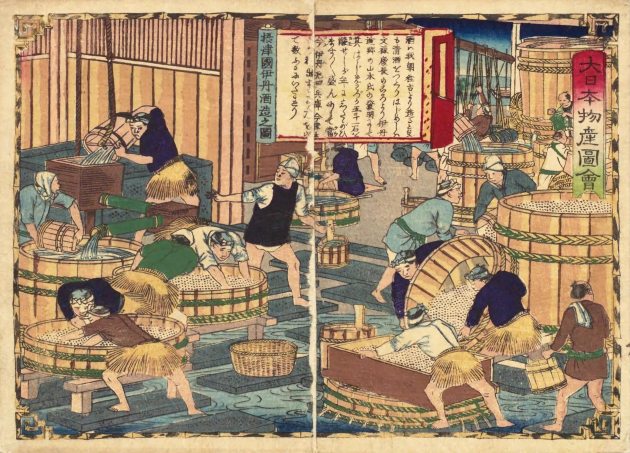
With the Edo period (1603–1868), the center of sake brewing gradually shifted from Nara to Itami in present-day Hyogo Prefecture. A key factor was the refinement of yeast starter methods suited to kan-zukuri, or winter brewing.
In Itami, brewers developed techniques that addressed the extended fermentation times caused by low winter temperatures. These methods were refined into what is now known as kimoto, one of the foundational yeast starter methods still used today.
For a more detailed discussion of kimoto, see the related article:At the same time, the organization of seasonal brewery workers, or kurabito, improved productivity. This labor structure made large-scale winter brewing possible, and Itami’s sake—known as Itami Morohaku—gained widespread popularity in Edo.
Later, a shogunate-led deregulation of sake brewing in 1754 helped bring broader recognition to the sake of Nada, now one of Japan’s most famous brewing regions.
While Nada’s brewing methods drew on the traditions of Nanto and Itami Morohaku, innovations such as exclusive winter brewing and shorter brewing cycles enabled the consistent mass production of high-quality sake. Through these changes, sake brewing developed into a full-fledged industry.
Scientific Advancement and the Development of Brewing Technology
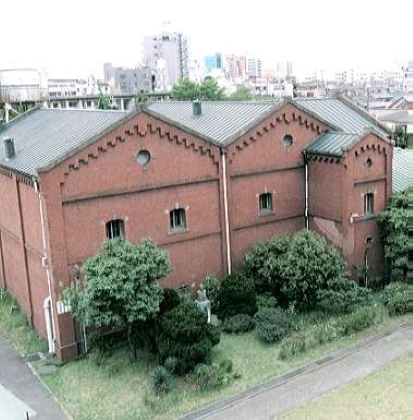
In 1904, the Meiji government established the National Research Institute of Brewing, aiming to improve sake quality and refine brewing methods. Research into the microorganisms involved in sake production advanced rapidly, leading to significant technological progress.
In 1909, Kinichiro Kagi developed yamahai-moto, eliminating the labor-intensive yamaoroshi step required in kimoto. The following year, Kamajiro Eda introduced sokujo-moto, further advancing yeast starter technology.
For more detailed discussions of yamahai and sokujo-moto, see the related articles:Sokujo-moto suppresses unwanted microorganisms by adding lactic acid at the outset, allowing selected yeast to propagate safely. Its reliability and microbiological stability have made it the dominant yeast starter method in modern sake brewing.
At the same time, sake yeast research progressed. Yeast was successfully isolated from moromi in 1895, and the Brewing Society of Japan, founded in 1906, began isolating and breeding yeast strains.
After yeast was isolated from the starter of Nada-based brewery Sakuramasamune in 1906, systematic cultivation and distribution followed. From 1917 onward, strains were numbered and distributed nationwide as Kyokai yeast, forming the basis of contemporary sake brewing.
For a more detailed discussion of Kyokai yeast, see the related article:Research and Development Expanding the Diversity of Sake
In recent years, research has begun to focus directly on multiple parallel fermentation itself. One such initiative brings together Shimizu Seizaburo Shoten (brewer of Zaku), craft sake brewery Linné, Ikuhi LLC, and the Nara Institute of Science and Technology.
This collaborative project examines multiple parallel fermentation—long understood through experience—using modern bioscience techniques, including gene expression analysis.
By exploring the “new significance” of multiple parallel fermentation, such research may reveal previously unrecognized values in sake brewing, further expanding the diversity and potential of sake.
Summary
From the era of kuchikami-zake to the present day, accumulated knowledge and ongoing research have continuously shaped sake brewing, resulting in the safe and remarkably diverse techniques used today.
Multiple parallel fermentation, sensitive to factors such as temperature and mash formulation, is a challenging system to manage. Precisely because of this complexity, it can be seen as a fermentation method that deeply defines the identity of sake.
As research continues—drawing on modern technology and increasingly detailed analysis—the possibilities for further evolution in sake brewing remain both broad and promising.
References
- Horie, Shuji. The Path Sake Has Taken: Historical Perspectives on the Evolution of Sake Brewing Methods. Imai Publishing, 2014.
- Ono, Yoshio. “Innovation in the Sake Brewing Industry I.” Hikone Ronso, 2021.
- Ono, Yoshio. “Innovation in the Sake Brewing Industry III.” Annual Report of the Faculty of Economics, Shiga University, Vol. 30, 2023.
- Ono, Yoshio. “Innovation in the Sake Brewing Industry IV.” Annual Report of the Faculty of Economics, Shiga University, Vol. 31, 2024.
- Nara Institute of Science and Technology. “Shimizu Seizaburo Shoten Co., Ltd., Linné Co., Ltd., Ikuhi LLC, and Nara Institute of Science and Technology Launch Joint Research to Explore the New Significance of Multiple Parallel Fermentation in Sake Brewing.” Press release, 2024.
Pickup Articles


2019.01.18

2019.01.25
Trending Articles


Popular Articles
Recent Articles