2026.06
03
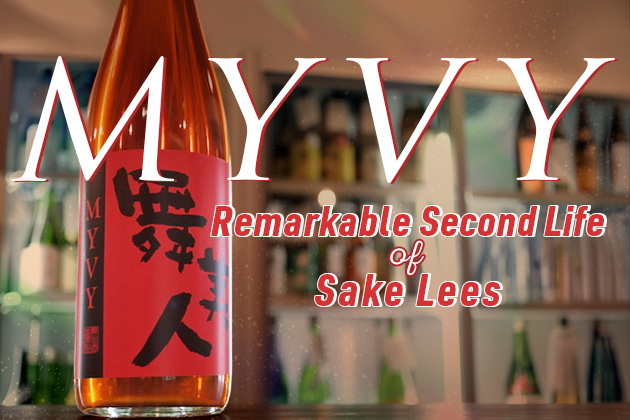
Nothing Wasted: MYVY, the Remarkable Second Life of Sake Lees — Mikawa Shuzojo, Fukui (Maibijin)
After the fermented moromi mash is pressed, what remains is sake lees, known in Japanese as sake kasu. The exact amount varies depending on the brewery and brewing method, but it typically accounts for roughly 20–30% of the mash. In most cases, sake lees are sold directly at breweries or specialty shops for home use, or supplied to restaurants and food producers as a culinary ingredient.
At Mikawa Shuzojo, however, the process does not end there. The brewery takes this byproduct and transforms it into an entirely new kind of alcoholic beverage: the lees are packed into tanks and left to re-ferment and mature for over a year before being pressed. The result occupies a category of its own — evoking overripe fruit, the layered complexity of long-aged pickles, and the deep, savory sweetness of soy sauce or miso, all concentrated in a single glass.
This beverage is produced in extremely limited quantities and has been commercialized under the name MYVY, now a signature offering of the Maibijin label.
We spoke with Kinya Mikawa, owner and head brewer (toji), about how this unconventional product came to be.
Why Re-Ferment Sake Lees?
– What first led you to consider fermenting sake lees a second time?
"From late June onward, we produce what is known as fumikomi kasu — lees that are tightly packed into tanks and left to mature for about six months, primarily for use in pickling vegetables. In recent years, however, fewer households have been making pickles at home, and we increasingly found ourselves with surplus lees that we could not sell.
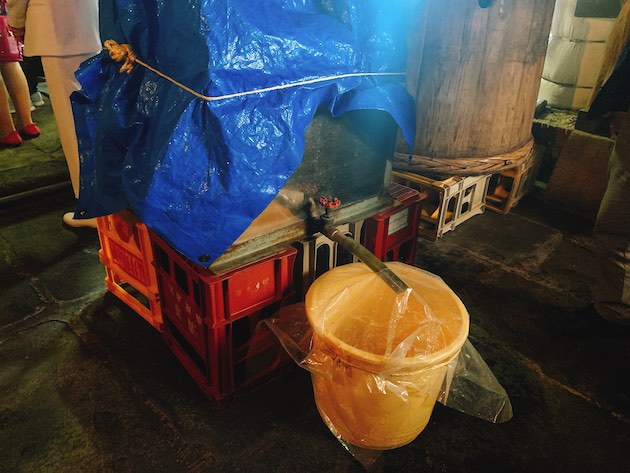
There was also a practical challenge. Because we press all of our sake using traditional wooden vats, the resulting lees are quite soft. During the summer months, liquid rises to the surface of the tanks and needs to be removed regularly — a process that is more labor-intensive than it might seem."
– So you were actively searching for ways to utilize the surplus?
"Not exactly. It began almost by accident. One day, I noticed a golden-amber liquid seeping out from the aged lees. On a whim, I scooped some up and tasted it. What I encountered was a depth and sweetness unlike anything I had come across before, along with a refined alcoholic warmth. My immediate reaction was simply that it was delicious.
I bottled a small amount and sent it to a specialty junmai sake retailer in Kyoto that we work with. The response was overwhelmingly positive — those who tasted it described it as something genuinely out of the ordinary.
That reaction led to roughly two years of trial and error, ultimately resulting in the idea of pressing the re-fermented lees in the same way one would press a conventional sake mash."
The Name MYVY — Intentionally Mysterious
– Two years is a considerable amount of time. How much product do you obtain from a single pressing?
"After extended aging, the lees become extremely soft — almost paste-like in consistency. We pack them into the same cloth bags used for pressing sake (approximately 60 cm tall and 30 cm wide), arrange twelve bags in alternating layers inside a handmade press, and slowly apply pressure using a screw jack. Each pressing yields the equivalent of about eighteen 1.8-liter bottles. This process is repeated over roughly four months, producing a total of around 120 to 160 bottles."
– Does the flavor vary from year to year?
"Surprisingly, it remains relatively consistent. I believe the extended maturation period of one to two years functions as a kind of natural equalizer, smoothing out annual variations. The result is a beverage rich in amino acids and peptides, which contribute to its pronounced depth and umami character."
– How did the name MYVY come about?
"I came up with it myself. We have a character called Maibii-chan, the mascot of the Maibijin label, who appears in our monthly newsletter for distributors and retailers. That served as a starting point.
For a long time, we had been describing the product simply as 're-fermented sake lees,' but customers often found that difficult to grasp. I decided that if the product was going to be unfamiliar, it might be better to lean into that ambiguity rather than fight it.
The name combines 'MY' from Maibijin and 'VY,' inspired by the word 'ivy' — as in the Ivy Look, the preppy style that took hold in Japan in the 1960s. I wanted something that would prompt curiosity rather than offer a straightforward explanation."

Summary
MYVY is a rare and labor-intensive beverage produced by allowing sake lees to re-ferment and mature for over a year before pressing. Born from a combination of necessity and experimentation, it represents one of the more unusual applications of traditional sake-making technique. With an annual output of only 120 to 160 bottles, it stands as a compelling example of how byproducts can be reimagined through patience and craft — and why it continues to attract attention well beyond the world of conventional sake.
Pickup Articles


2019.01.18

2019.01.25
Trending Articles


Popular Articles
Recent Articles