2026.05
06
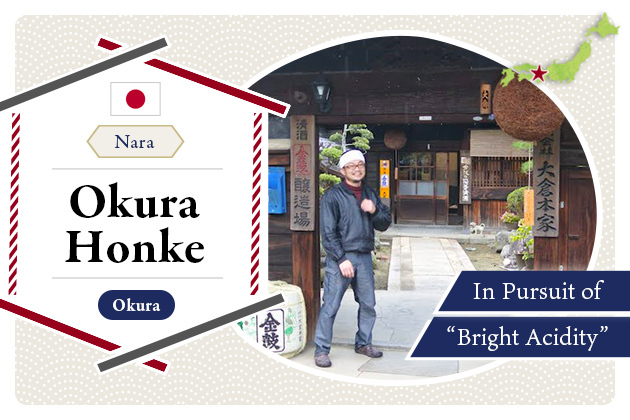
In Pursuit of “Bright Acidity”: The Revival of Okura Honke and Its Characterful Sake
Okura Honke is a sake brewery located in Kashiba City, Nara Prefecture. As you make your way through a quiet residential neighborhood, a thatched-roof office comes into view beyond the gate—an evocative reminder of the brewery’s long history.
Since its founding in 1896, the vast majority of sake produced at Okura Honke has been brewed using the yamahai method, known for yielding bold, distinctive flavors. This robust and characterful style has earned enduring popularity across generations.
In 2000, however, the brewery was forced to suspend production after its third-generation head, Katsuhiko Okura, fell ill. It was Takahiko Okura, the fourth-generation successor whom we spoke with for this article, who ultimately revived the family tradition.
How did a brewery that once halted production find its way back? And how did Takahiko—formerly a company employee in Yokohama—come to take up sake brewing? This article traces that journey while offering a close look at the brewing philosophy and practices of Okura Honke.
- A Brewery Shaped by Tradition and Hands-On Craft
- From Reluctant Return to Revival: Reclaiming a Brewery’s Legacy
- Learning from Nothing: Brewing and Rice Cultivation from Scratch
- Yamahai at the Core: Toward a Brighter, More Approachable Expression
- Mizumoto, Ritual Heritage, and Bold Experimentation
- Summary
- Brewery Information
A Brewery Shaped by Tradition and Hands-On Craft
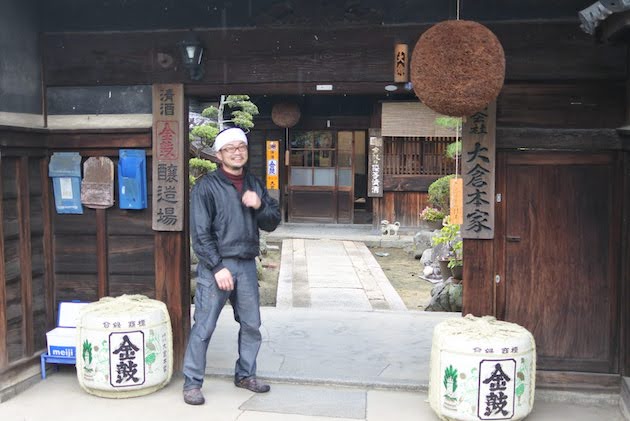
The brewery buildings, constructed with wood and earthen walls, immediately draw the eye with their traditional architecture. Guided by Takahiko, we pass through the office and kitchen before entering the brewing area, where the first thing we encounter is the equipment for raw material processing.
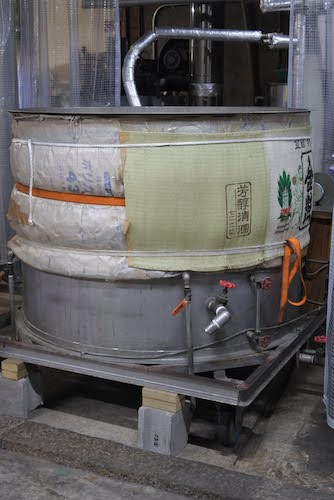
At Okura Honke, a portion of the rice is cultivated in-house. Carefully grown, the rice is washed in small batches using a machine, then soaked by hand before being steamed in a traditional koshiki steamer.
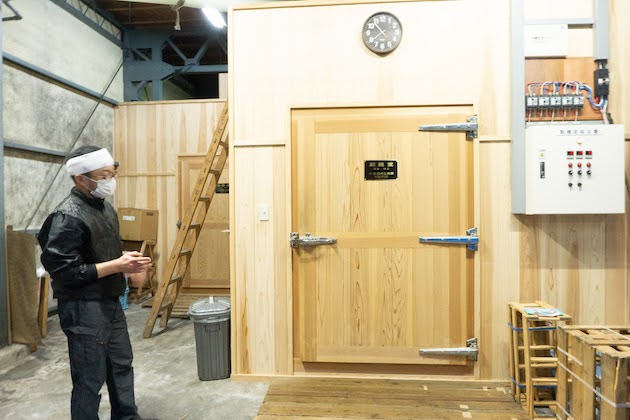
Beyond this lies a pristine koji room, newly built after Takahiko returned to the brewery. In recent years, the brewery has further introduced a floor-type koji-making machine manufactured by Hakuyo.
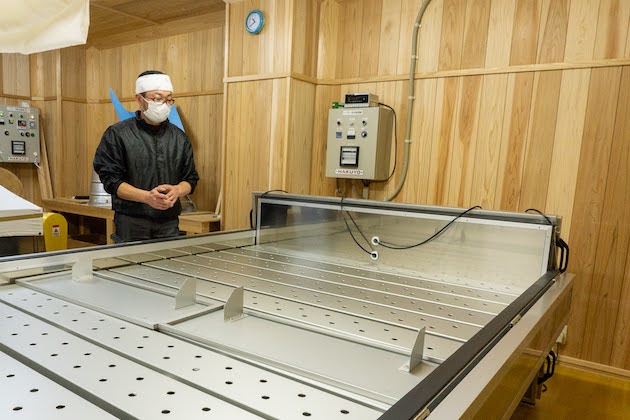
At times, when the rice is brought into the koji room, the temperature must be lowered to adjust moisture levels. Previously, to bring the temperature back up, hot carpets were placed beneath the wooden koji beds (toko). With the new machine, however, dedicated heaters are installed, minimizing temperature inconsistencies while also improving operational efficiency.
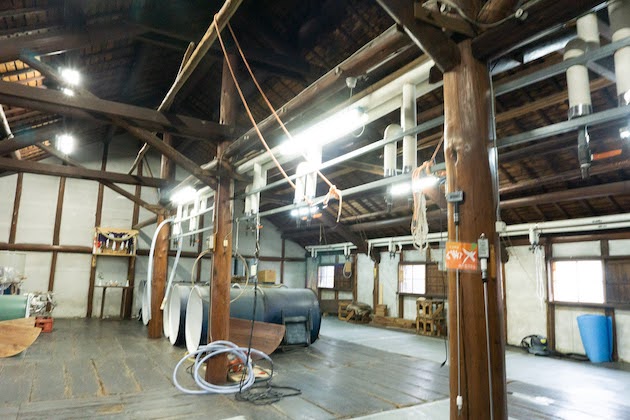
Climbing a steep staircase to the second floor, we arrive at the shubo room, where the yeast starter has been prepared both in the past and today. Once completed, the shubo is carried down to the first floor entirely by hand. Even descending the staircase empty-handed is challenging—so the idea of repeatedly carrying heavy shubo down those steps ismind-blowing.
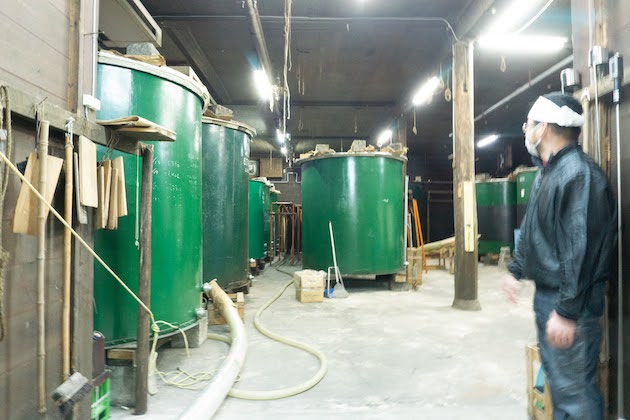
Back on the first floor, we enter the area lined with tanks filled with moromi. What stands out is Takahiko’s gentle, attentive gaze as he looks over the carefully prepared mash.
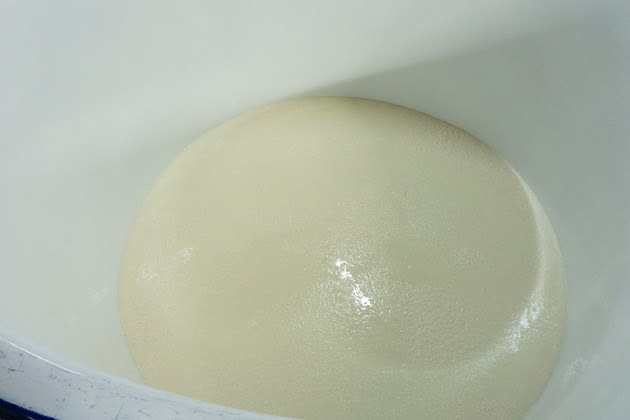
When we visited in October, the mizumoto-style moromi was being prepared. A soft yet distinctive acidity filled the air with an exceptionally pleasant aroma—so captivating that one wishes it could be conveyed through the page itself.
From Reluctant Return to Revival: Reclaiming a Brewery’s Legacy
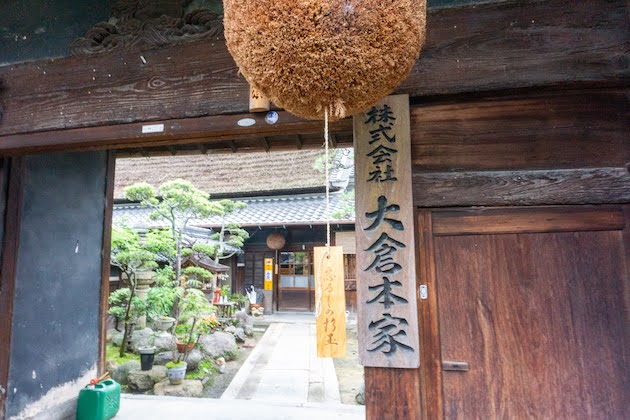
Takahiko returned to the brewery in 2001, the year after his father, Katsuhiko—the previous head—fell ill. At the time, Okura Honke had already suspended production.
Leaving behind his life as a company employee in Yokohama and returning home to take over sake brewing with no prior experience was, by any measure, a significant decision. One might assume it was driven by a strong sense of duty to preserve the family legacy. Yet Takahiko recalls it differently.
“I had gotten used to city life, so I came back reluctantly. I didn’t want to return to the countryside, to be honest. And even after coming back, I had no intention of making sake.”
In fact, he initially returned not to inherit the brewery, but to help bring the business to a close. His father had expected the same. Knowing firsthand the hardships of sake brewing, Katsuhiko may have hoped to spare his son from that burden.
So how did Okura Honke ultimately find its way back?
The turning point came during a delivery Takahiko made to a local liquor store.
“Are you really going to let the brewery go?” the shop owner asked.
“I… my father says he’s going to close it,” Takahiko could only reply. In response, the shop owner spoke at length about the history of the brewery and how exceptional Okura Honke had once been.
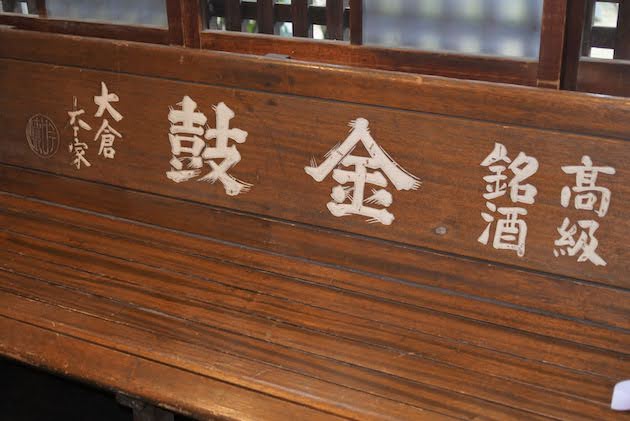
“Wait… our brewery is actually that important?”
Startled by this realization, Takahiko immediately told his father he wanted to take over and tried to persuade him. Katsuhiko, however, responded curtly:
“What could you possibly understand?”
That single remark became the catalyst. “I’ve always had a contrarian streak,” Takahiko says with a faint smile. It was at that moment that he began, for the first time, to genuinely want to make sake.
Over the next two years, he continued to persuade his father, who remained bedridden. He also brought back the former toji who had overseen brewing before production was halted. In 2003, Okura Honke was successfully revived.
Learning from Nothing: Brewing and Rice Cultivation from Scratch
Having resolved to take over the brewery, Takahiko began studying sake brewing on his own. Most of the books once kept at the brewery had already been discarded by the previous generation, leaving him to seek out knowledge independently. At a time when the internet was still in its early stages, his learning began by searching “nihonshu” on a mobile phone and browsing the websites of major breweries, as well as ordering every book on sake he could find through the nascent Amazon marketplace.
Of course, knowledge alone does not make sake. Takahiko then undertook five years of rigorous training under a Tajima-style toji. In the sixth brewing year after the revival (2008BY), he assumed the role of toji himself, becoming, in both name and practice, the successor to Okura Honke’s brewing tradition.
At the same time, he also began cultivating rice—almost concurrently with learning to brew.
“At first, I had no intention of using the rice we grew for sake,” he explains.
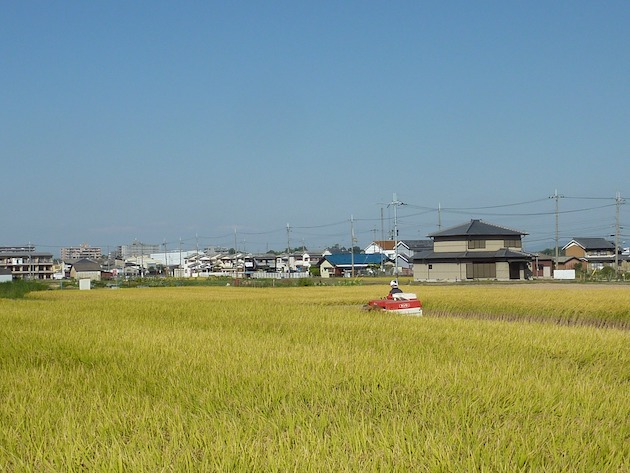
The decision stemmed from necessity: a rice field behind the brewery was about to be abandoned due to a lack of farmers. “If no one else would do it, I thought I should,” he says.
Yet, as he admits, “I didn’t even know the difference between a tractor and a combine harvester at the beginning.” Like brewing, rice cultivation started from complete inexperience.
In the rural area surrounding the brewery, it was rare to see a young person working in the fields. Locals gathered along the roadside to watch. At times, unable to bear watching his clumsy efforts, onlookers would call out, “You’re doing it all wrong—let me take over!” Through this unexpected mentorship from more experienced farmers, Takahiko gradually acquired the skills needed for rice cultivation.
In this way, both sake brewing and rice growing—each essential to the identity of Okura Honke—were rebuilt from the ground up.
Yamahai at the Core: Toward a Brighter, More Approachable Expression
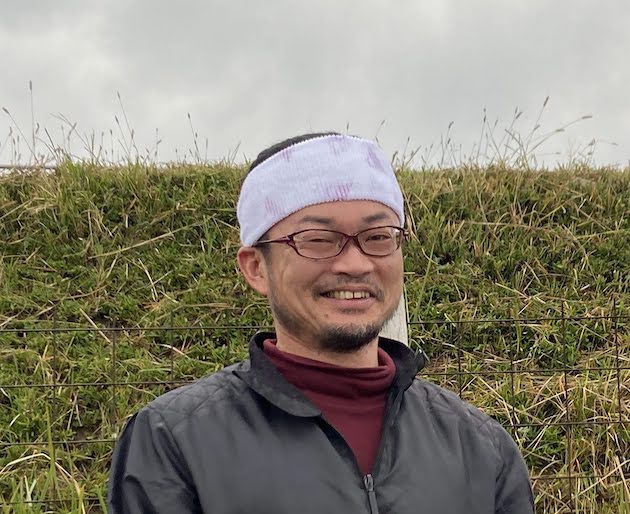
At the heart of Okura Honke’s identity is its unwavering commitment to the yamahai method. Since its founding, the brewery has consistently produced yamahai-based sake—styles long cherished by local drinkers for their depth and structure, often described as “firmly grounded” or full-bodied.
According to Takahiko, yamahai naturally suits the climate and sensibility of the region. Looking ahead, however, his aim is to craft a style that is more approachable—yamahai with a bright, lifted acidity.
“Rather than a sunset, I think of it as a sunrise. I want to create sake with a fresh, youthful acidity.”
Mizumoto, Ritual Heritage, and Bold Experimentation
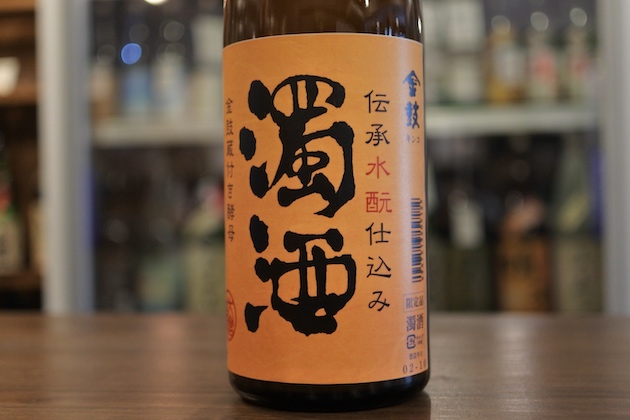
Another defining feature of Okura Honke is its traditional mizumoto-style nigori sake. Since around 1932, the brewery has been commissioned by the Nara Prefectural Shrine Association to produce sacred sake for the Niinamesai harvest festival, using an unchanged, time-honored method.
For many years, this mizumoto sake was brewed exclusively as an offering to the gods. However, beginning in 2004, it was released commercially, allowing the public to experience its distinctive character.
As with the brewery’s revival itself, this decision was prompted by a single remark from a liquor retailer. One day, while the previous generation was still managing the brewery, a retailer happened to witness the preparation of the sacred mizumoto sake and later urged Takahiko:
“You should be making that sake. Please, produce it.”
When Takahiko shared the idea with the toji, he responded enthusiastically, urging that they proceed. Encouraged by these voices, the team set out to produce mizumoto nigori for the first time.
Traditionally, mizumoto starter cultures were prepared in warmer seasons to support the activity of lactic acid bacteria. However, when Okura Honke brewed it in winter, the result was an unexpectedly high-acid sake.
“When I first tasted it, it was so sour that I thought we had failed,” Takahiko recalls.
Yet upon release, the sake was met with overwhelming acclaim. Its vivid, grapefruit-like acidity proved especially appealing, quickly earning a strong following. While the first batch was brewed in December, the brewery has since shifted to a September brewing schedule, in line with historical practices, to improve consistency.
Mizumoto nigori, fermented through the action of wild lactic acid bacteria, is both captivating and demanding. Its lively acidity and delicate effervescence make for a compelling drinking experience, but the process carries a high risk of failure and requires meticulous care.
The challenges extend further when producing sake for ritual use. All offerings must be pasteurized through bin-kan (bottle pasteurization), a particularly labor-intensive process for nigori sake. Because of its dense, unfiltered texture, each bottle must be manually stirred with a rod during heating to prevent it from thickening into a porridge-like consistency. For nearly 2,000 bottles, this process is carried out by a team of two to three people—an extraordinary feat of labor.
Even within such demanding traditional methods as yamahai and mizumoto, Okura Honke continues to experiment. The brewery also produces sake incorporating distinctive techniques such as koji yon-dan (a four-stage addition using koji) and ichidan jikomi (single-stage fermentation), pushing beyond conventional frameworks.
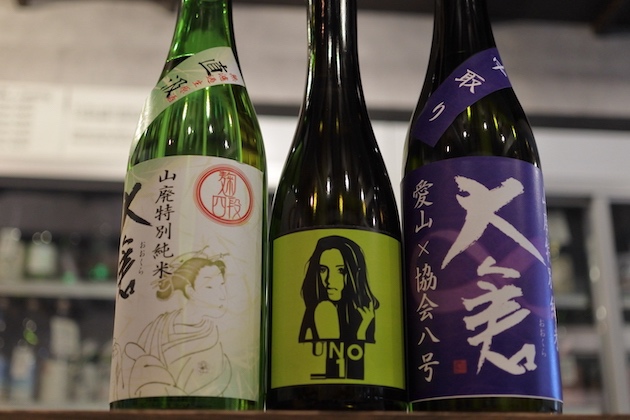
“If I’m going to do something, I want it to be different from others,” Takahiko explains.
Rather than making incremental adjustments—such as changing only the rice variety or yeast strain—he often opts for more radical variation, altering both simultaneously.
“When I find something in old brewing texts that no one is doing anymore, I feel compelled to try it. If we’re making multiple types of sake, I’d rather create bold, unmistakable differences than subtle variations. It’s clearer, and more enjoyable that way.”
Throughout our conversation, Takahiko spoke about his craft with a bright, unburdened smile, never once conveying the hardships that undoubtedly accompany such work. At Okura Honke, it seems likely that many more distinctive and engaging sake will continue to emerge in the years ahead.
Summary
From the moment his father firmly rejected the idea of reviving the brewery, Takahiko has held on to a single, unwavering conviction: he wants to somehow change what is deemed “impossible.” Supported by this determination, Okura Honke began moving forward once again—reviving its traditional brewing while also giving rise to a new generation of sake.
“Honestly, if I could go back to when I first thought about reviving the brewery, I’d tell myself: don’t do it! It’s just too hard,” he says with a laugh.
Despite the immense challenges, Takahiko approaches his work with both care and a spirit of bold experimentation. What stood out most, however, was how remarkably bright and cheerful he remained throughout—never once revealing the weight of those hardships.
“For me, the connections I’ve made through sake are what keep me going,” he reflects.
Listening to his story, it became clear that the sake of Okura Honke is shaped by the warmth and support of many people. That will surely remain true in the years to come. It was a conversation that made the brewery’s distinctive character and quiet strength feel deeply convincing.
Brewery Information
Okura Honke
Address: 692 Kamada, Kashiba City, Nara Prefecture, Japan
Founded: 1896
President & Master Brewer: Takahiko Okura
Website: https://kinko-ookura.com/index.html
Pickup Articles


2019.01.18

2019.01.25
Trending Articles


Popular Articles
Recent Articles