2026.03
24
Japan's Sake Brewery Ownership Landscape - Sake M&A Guide
With the exception of licenses issued exclusively for export purposes, new licenses to produce sake are no longer granted in Japan.
Under these circumstances, one of the most effective ways to newly enter the sake production business is to acquire an existing company that already holds a sake brewing license through M&A.
However, this approach presents its own challenges. In addition to the specialized expertise required to execute an M&A transaction, the unique characteristics of sake breweries as a business further increase the level of difficulty. When post-acquisition management is taken into account, the hurdles may, in some respects, be even higher than those involved in starting a company from scratch.
This series aims to organize key knowledge and information related to M&A involving sake breweries, helping those interested in the sake business gain a solid foundational understanding and move more smoothly toward in-depth research and consideration. As part of this effort, we also conducted a survey of companies that have acquired sake breweries as buyers over the past decade.
In this article, we will outline the current landscape surrounding M&A in the sake brewery sector, along with its significance and the challenges it entails.
*The original article is published on November 2023
The Landscape Surrounding Sake Brewery M&A
An Overview of the Domestic M&A Market for Small and Medium-Sized Enterprises
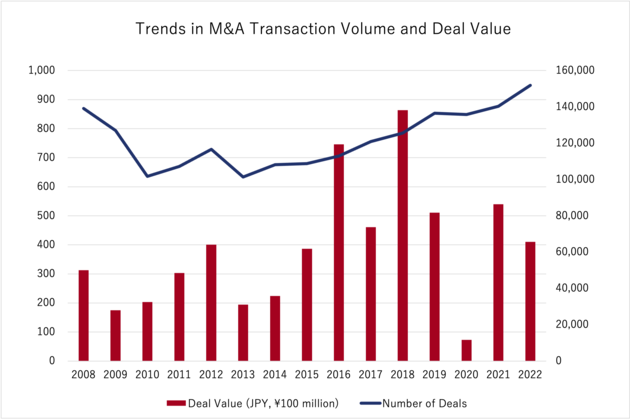
To begin, let us take a broad look at the current state of the M&A market. Unfortunately, there are no comprehensive statistics specifically tracking M&A transactions involving sake breweries. As such, we will refer to various datasets on domestic M&A activity in Japan and use them as a basis for analysis.
Within Japan, the number of M&A transactions has continued to increase over the past decade, starting around 2013. While total transaction values fluctuate from year to year, these variations are largely attributable to the presence or absence of mega-deals exceeding one trillion yen. Overall, it is fair to say that Japan’s domestic M&A market is on a clear growth trajectory.
When it comes to M&A involving small and medium-sized enterprises—including sake breweries, and especially very small businesses—a significant proportion of transactions are conducted privately and therefore are not captured in the statistics mentioned above. As a result, there are no precise figures for the total number or value of SME M&A transactions.
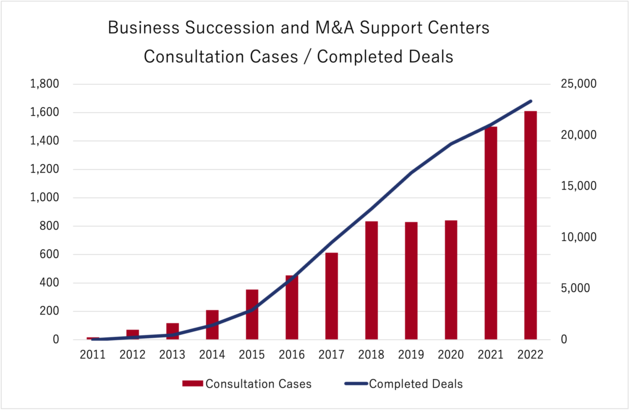
That said, according to the Organization for Small & Medium Enterprises and Regional Innovation, JAPAN (SMRJ)—a government-affiliated institution that oversees the Business Succession and M&A Support Centers—activity has increased dramatically. Based on performance data from fiscal year 2022, the number of consultation cases handled by these centers was approximately 23 times higher than a decade earlier, while the number of completed deals had grown by roughly 99 times. Since the centers were established in 2011, both consultation and transaction volumes have continued to rise steadily.
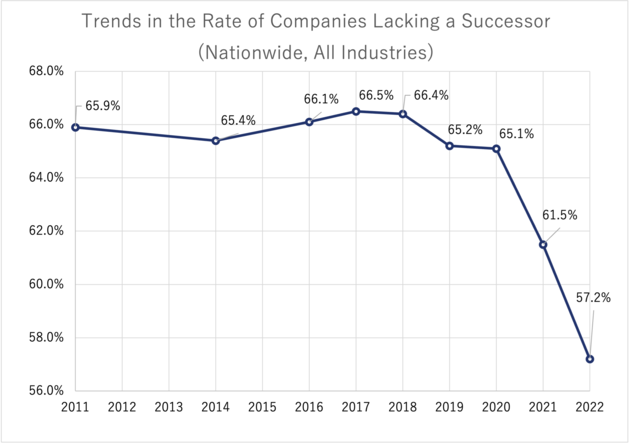
Key factors behind this increase include the growing number of business owners retiring due to Japan’s aging population, coupled with a persistent shortage of successors. According to the Teikoku Databank survey titled “Trends in the Rate of Companies Lacking a Successor Nationwide,” the proportion of Japanese companies without a designated successor declined significantly between 2020 and 2022. Even so, it remains at a high level of nearly 60 percent nationwide.
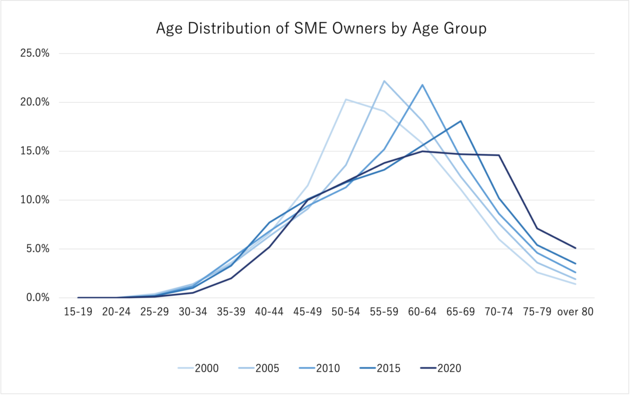
An examination of the age distribution of SME owners shows a clear trend toward aging between 2000 and 2020. At the same time, the average age at which company presidents are replaced has remained consistently high—around 65 to 70 years old. This indicates that a growing number of companies face the risk of being unable to arrange succession in time.
Against this backdrop, M&A has increasingly come to be viewed in Japan as a practical and acceptable option for business succession. Whereas it was once associated with a strong sense of resistance or the stigma of “selling out,” M&A has become more widely understood and normalized in recent years. At the same time, support frameworks provided by public institutions and financial organizations have been steadily strengthened. Together, these developments have made M&A an effective tool for business succession, contributing to the continued rise in the number of transactions.
An Overview from the Seller’s Perspective
The issue of a lack of successors, which is common among small and medium-sized enterprises, also applies to sake breweries. In addition, the sake industry faces challenges unique to its sector. Over the past 30 years, total sake production volumes have declined by approximately 70 percent, creating a harsh market environment. As a result, the number of breweries struggling financially—as well as those forced to suspend operations or shut down entirely—has increased.
Reflecting these conditions, the total number of sake breweries in Japan has fallen to roughly two-thirds of its level 30 years ago.
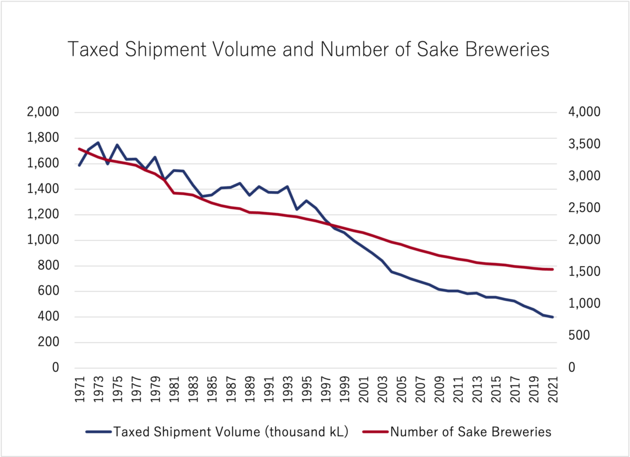
In the statistics cited above, only breweries that have either closed their businesses or surrendered their licenses are counted as part of the overall decline. However, if one also includes operators that have chosen to suspend brewing while retaining their licenses, it is reasonable to assume that an even larger number of sake breweries have been forced into a position where continuing to brew sake on their own is no longer viable.
As noted earlier, there are no comprehensive statistics on the number of M&A transactions involving sake breweries. Nevertheless, against the backdrop of successor shortages and financial difficulties, it is likely that—much like other small and medium-sized enterprises—the number of sake brewery M&A transactions has increased in recent years.
An Overview from the Buyer’s Perspective
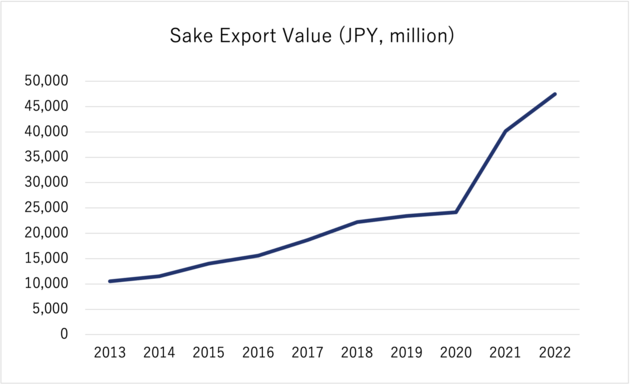
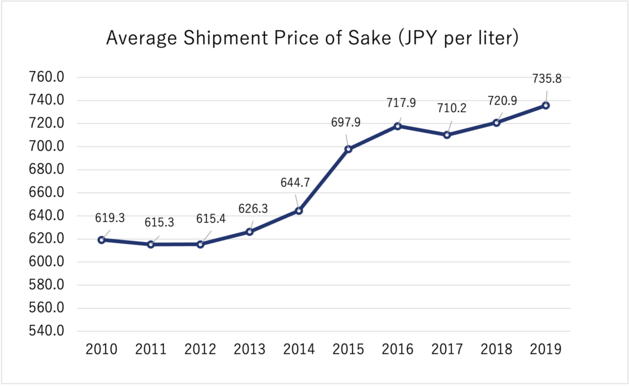
While the overall sake market in Japan continues to contract, there has been noticeable growth in certain segments, including overseas exports and higher-priced products—particularly those classified as tokutei meisho-shu (special designation sake). Against this backdrop, a growing number of individuals and companies appear to see opportunity in the sector and are increasingly interested in producing sake themselves.
Because licenses to produce sake are currently not being issued in Japan—except those limited to export purposes—M&A becomes a highly viable option for operators with the ambitions described above.
Other approaches do exist, such as contract brewing (OEM), producing so-called Craft Sake by obtaining a license for “other brewed alcoholic beverages,” or acquiring an export-only sake license. However, for those who wish to produce ‘Japanese sake (nihonshu)’ at their own facilities and sell it domestically, M&A is, in practice, almost the only available option.
If only seller-side demand for M&A were increasing, one might expect the market to favor buyers—that is, sake breweries as sellers could be acquired at relatively low prices. However, interviews conducted by SAKE Street with industry stakeholders indicate that the cost of acquiring breweries that have suspended production has risen sharply in recent years. This suggests that buyer-side demand is also increasing, reinforcing the view that interest in acquiring sake breweries is growing on both sides of the market.
The Significance of Sake Brewery M&A
As discussed so far, the factors driving the increase in M&A involving sake breweries have largely been defensive in nature: on the seller’s side, a lack of successors and financial difficulties; on the buyer’s side, the reality that there are virtually no alternative paths to entering sake production. That said, the growing prevalence of M&A also carries important implications for the sake industry itself.
Preserving a “World-Leading” Heritage
One of the most significant benefits of an active M&A environment is that it increases the likelihood that historically important breweries and brands can survive. According to research by Nikkei BP Consulting, Japan is home to an exceptionally large number of long-established companies by global standards. Of all companies worldwide that have been in operation for more than 100 years, over half are Japanese, and among those with histories exceeding 200 years, nearly two-thirds are based in Japan.
This concentration of long-lived enterprises underscores the cultural and historical value embedded in sake breweries—and highlights how M&A can serve as a mechanism for passing that legacy on to the next generation rather than allowing it to disappear.
Among these long-established companies, sake breweries are particularly notable for their longevity. In his paper “The Sake Brewing Industry Possesses the World’s Longest-Lived DNA: The Value of Longevity” (Journal of the Brewing Society of Japan, Vol. 108, No. 2, 2013), Tsuneo Kita notes that 763 sake breweries in Japan have histories spanning more than 100 years. He further points out that, among the more than 200 companies featured in the The Nikkei series “200-Year Companies,” the overwhelming majority were sake breweries—leading him to conclude that “sake brewing is unquestionably Japan’s champion of corporate longevity, and therefore the world champion as well.”
In this sense, M&A plays an important role in reducing the risk that breweries and brands with such long histories will be lost. By facilitating succession, M&A makes it easier for the sake industry as a whole to preserve “history” as an asset. Of course, history alone does not guarantee commercial success. Nevertheless, there is little doubt that this accumulated heritage tends to work to the industry’s advantage—particularly as Japanese sake competes in overseas markets.
Operational Efficiency and Market Expansion Through Synergy
Another important significance of sake brewery M&A lies in what is commonly referred to as “synergy.” In the context of M&A, synergy is defined as “the benefits that arise when the buyer and seller mutually leverage their respective management resources, producing greater value than either company could generate through its business activities alone” (from All About M&A Practice, Revised 5th Edition, edited by Tatsuaki Kitaji et al., Nikkei Business Publications).
By introducing perspectives from outside the sake industry, M&A can lead to greater operational efficiency. Moreover, by combining a brewery’s assets with the buyer’s existing businesses, networks, or capabilities, there is also potential to expand the market for sake itself.
A concrete example of improved operational efficiency can be seen in the case of Kanai Shuzoten in Kanagawa Prefecture. Following its acquisition, the brewery received support from Kujira Capital, which joined its management team. Through initiatives such as launching an e-commerce website within a single week, actively utilizing social media, and streamlining back-office operations through IT adoption, the company succeeded—within one year—in increasing sales by 1.2 times while cutting its operating loss by half.
This case illustrates how synergy created through M&A can translate not only into financial improvement, but also into structural modernization that strengthens a sake brewery’s long-term competitiveness.
With regard to market development, a notable example is Tsunan Jozo in Niigata Prefecture, where FARM8, a company specializing in research and development of fermented foods, has joined the management team. Through this partnership, Tsunan Jozo has expanded its sales channels by developing GO POCKET, a pouch-packaged sake designed for outdoor use; offering bundled products with FARM8’s homemade sake cocktail kit Ponshu Gria; and collaborating with SAKE POST, a subscription service for pouch-packaged sake.

In this way, for Japan’s sake industry—which faces a declining domestic market and a growing number of financially distressed producers—the activation of the M&A market holds significant importance.
Challenges of Sake Brewery M&A
As discussed above, M&A involving sake breweries has gained momentum in recent years and carries significant potential value. Nevertheless, a number of challenges remain. For this series, we conducted an anonymous survey targeting companies and individuals that had acted as buyers in sake brewery M&A transactions over the past ten years (54 in total, of whom 43 were contactable). We received responses from 12 respondents, representing approximately 28 percent of the target group. Drawing on the results of this survey, we will outline the key challenges surrounding sake brewery M&A.
Lack of Know-How on Both the Seller and Buyer Sides
On the seller side, many sake breweries are family-run businesses. In numerous cases, they have not been managed with the assumption that shares would be sold to parties outside the family. In practice, many operate as sole proprietorships or under corporate forms such as limited partnerships, which are not necessarily well suited to equity transfers.
As a result, seller-side owners are required—often within a limited timeframe before succession—to organize their existing situation and, at the same time, acquire the necessary know-how to negotiate with potential buyers and prepare for an M&A transaction.
On the buyer side as well, M&A or business succession is often not something that has been actively considered from the outset. Instead, M&A is frequently chosen, in a sense, as an unavoidable option—as a means of entering the sake production business.
Moreover, because sake breweries are typically small, family-run enterprises, information regarding transaction structures, valuations, and deal terms is rarely made public. This makes it difficult for both sides to gather reference cases or benchmark data.
In the survey conducted for this series, the most common response to the question of “the purpose of the M&A” was “to acquire a sake brewing license.”
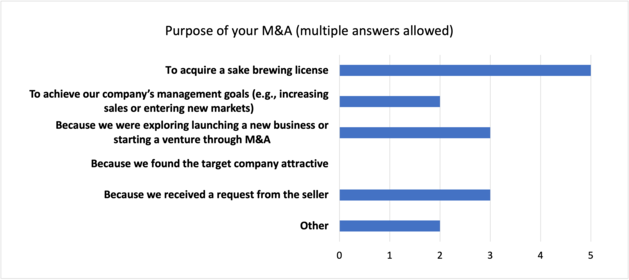
In such cases, buyers may find themselves forced to learn about M&A from scratch immediately before launching their business. As a result, many buyers are likely to enter M&A transactions without having had sufficient time to build up the necessary expertise or conduct thorough information gathering.
Latent Seller Demand and the Difficulty of Deal Sourcing
Although cases of brewery closures, suspensions, and M&A transactions are increasing, information specifically related to sake brewery M&A is still not widely listed on matching databases or similar services. While M&A has become more accepted in Japan overall, there remains, in some quarters, a perception of selling a business as something akin to a “loss of face.” This tendency is particularly strong among traditional companies and those led by older owners.
In fact, many of the M&A cases from the past decade referenced earlier were concluded through personal connections rather than formal platforms. The survey conducted for this series reinforces this point: the most common answer to the question of “how deals were sourced” was “introductions.” Moreover, when asked which methods were “particularly effective,” the combined responses of “introductions” and “pre-existing relationships” accounted for approximately 75 percent of all answers.
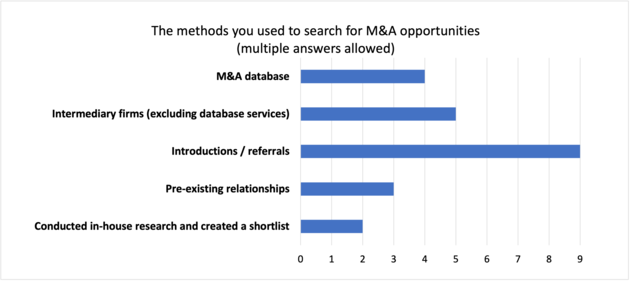
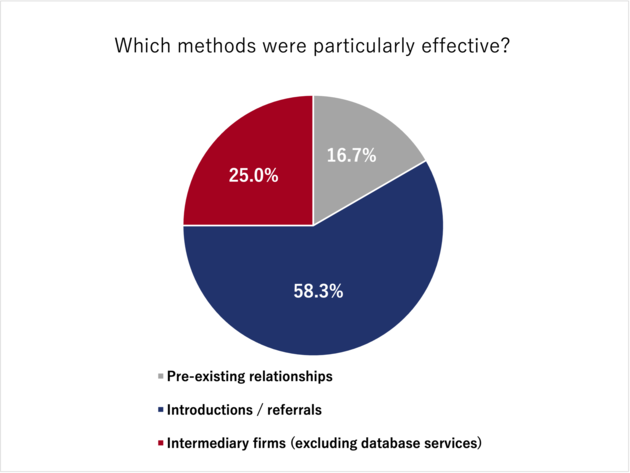
While this issue is not unique to sake breweries, it suggests that information about potential sellers often circulates only within local or insider networks. For individuals or companies that lack access to such networks, simply finding potential M&A opportunities can be extremely difficult.
Industry-Specific Factors: Licensing, Brewing Operations, and Distribution Practices
There are also circumstances unique to the sake industry. For example, sake breweries are businesses that require a liquor manufacturing license. In the context of M&A, careful consideration must be given to which transaction structure should be used in order to ensure that this license can be properly retained or transferred after succession.
When considering post-merger management, it is also essential to account for the specific characteristics of sake brewing operations. As a traditional industry that relies on the handling of microorganisms, sake production often involves challenges related to labor conditions and organizational structures that must comply with regulatory requirements. In some cases, these issues only become apparent during the M&A process itself or in the course of post-merger integration.
Distribution practices also differ from those of general food manufacturing. The sake industry commonly operates under the so-called “authorized dealer system,” in which products are shipped only to retailers that meet specific conditions agreed upon with the brewery. Along with this system, there are industry-specific approaches to quality control and other commercial customs that are distinct from standard food distribution models.
In addition, as will be explained in more detail in future articles, there are many other unique factors arising from the prevalence of traditional, family-run businesses within the industry. The need to understand these characteristics before pursuing an acquisition—or to work with advisors or intermediaries who possess specialized expertise in this area—further increases the complexity and difficulty of M&A involving sake breweries.
Summary
In thisarticle, we have outlined the overall landscape surrounding M&A involving sake breweries. While a number of challenges remain, M&A is not only an essential means of market entry for prospective buyers, but also a process that carries significant value for the sake industry as a whole.
In the future articles, we will shift to the buyer’s perspective and compile practical, actionable information on how to approach and execute sake brewery M&A effectively.
References
- Kitaji, Tatsuaki; Kitazume, Masahiko; Matsushita, Yoshichika; Ito, Kenji (eds.). All About M&A Practice, Revised 5th Edition. Nihon Jitsugyo Publishing, 2022.
- Kato, Masao (ed.). SME M&A: Perspectives and Practice from Lawyers and Certified Public Accountants. Nihon Kajo Publishing, 2018.
- M&A Online (ed.). M&A Yearbook 2023. Diamond, Inc., 2023.
- Small and Medium Enterprise Agency (Japan). “FY2022 Results of the Business Succession and M&A Support Program: Record High Numbers for Both Consultations and Completed Deals at Business Succession Support Centers.”
- Teikoku Databank. “Rate of Companies without a Successor Falls Below 60% for the First Time: Non-Family Successors Become the Leading Category, Accelerating the ‘De-Family’ Trend in Business Succession.” Accessed November 24, 2023.
- Small and Medium Enterprise Agency (Japan). White Paper on Small and Medium Enterprises 2022. 2022.
- fundbook. “Retirement of Business Owners Due to the Aging of SME Management.”
- National Tax Agency (Japan). Guide to Alcoholic Beverages (June 2023). 2023.
- Nikkei BP. “Research Data: 100-Year-Old Companies 2022 (Global Edition): Japanese Companies Account for 50% of Firms Founded Over 100 Years Ago.” Centennial Business Laboratory.
- Kita, Tsuneo. “The Sake Brewing Industry Possesses the World’s Longest-Lived DNA: The Value of Longevity.” Journal of the Brewing Society of Japan, Vol. 108, No. 2, 2013.
- Japan Innovation Review. “Case Study: The Revival of a 150-Year-Old Sake Brewery—How ‘DX × Capital’ Became the Turning Point (Part 2): Digital Transformation Supports Traditional Brewery Culture and Aims for the Global ‘SAKE’ Market.”
Pickup Articles


2019.01.18

2019.01.25
Trending Articles


Popular Articles
Recent Articles