2026.04
22
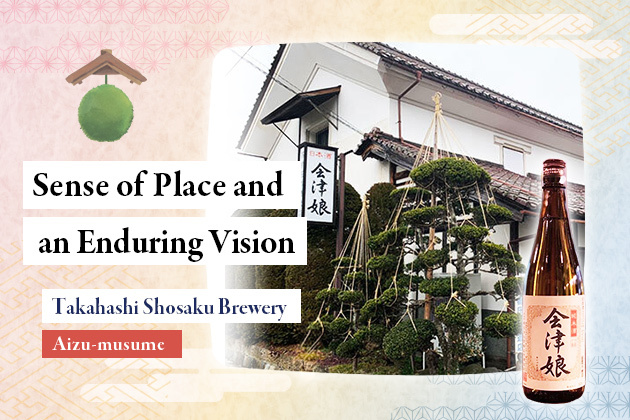
Aizu Musume, Sake Infused with a Sense of Place and an Enduring Vision — Takahashi Shosaku Brewery, Fukushima
Tondenmachi, located in the south-central area of Aizuwakamatsu City in Fukushima Prefecture, is a peaceful rural landscape surrounded by expansive rice fields and abundant nature. It is here that Takahashi Shosaku Brewery produces its signature sake, Aizu Musume.
The brewery practices a philosophy known as dosan doho—sake brewing rooted in local resources and methods. Alongside brewing, they also cultivate their own rice. Dosan doho refers to making sake using local rice and water, by local people, employing techniques suited to that land. Having long focused on the relationship between terroir, rice, and sake, Takahashi Shosaku Brewery remains at the forefront of integrating agriculture and brewing.
We spoke with owner-brewer Wataru Takahashi to explore his philosophy of sake production and the intentions behind their flagship label, Aizu Musume.
Foundations in Distribution and Brewing

After graduating from the Department of Brewing at Tokyo University of Agriculture, Wataru Takahashi joined Machidaya, a leading specialty sake retailer in Tokyo.
“Through the daily cycle of sourcing sake, making deliveries, and serving customers, I was able to experience the cutting edge of the market at the time while learning from the staff around me. After work, the late Mr. Kimura, who was the president then, would often call me over to his living room and talk with me at length about sake. He would ask for my thoughts from every possible angle, and at the same time, give me candid criticism. That’s how I learned how to think—and how to communicate.”
Takahashi later trained in sake brewing at the brewery Buyu in Ibaraki Prefecture. Surrounded by young and highly motivated colleagues, he says this was where he developed his fundamental approach to brewing.
“Everything that forms the foundation of my work today comes from my time at Machidaya and Buyu,” Takahashi reflects. Being immersed in both the distribution and production sides of sake at the forefront of the industry, he began to constantly ask himself questions such as: What kind of value can only I create? Why make sake in Aizuwakamatsu? And why at Takahashi Shosaku Brewery?
Defining Uniqueness Through Dosan Doho
Wataru Takahashi returned to the brewery in 1995. Reflecting on that time, he describes it as “an exceptionally fortunate environment in which to begin brewing.”
“In 1987, my father—who was the head of the brewery at the time—made the decision to discontinue the production of futsushu (table sake). Back then, futsushu dominated the market, so it was a difficult decision that went against the prevailing trends. Before the change, our annual production was around 800 koku, which then dropped to about 200–300.
However, by the time I returned, overall consumption of futsushu had sharply declined across the industry. Many breweries were struggling to reconsider the balance between their mainstay futsushu and the premium-designation sake they needed to grow. In our case, we had already eliminated futsushu, so we were able to focus entirely on expanding our tokutei meisho-shu (premium sake).”
Following the discontinuation of futsushu, Takahashi Shosaku Brewery chose to commit to dosan doho—a philosophy of making sake using local rice and water, by local people, with methods rooted in that land.
In a sense, this too was a decision that ran counter to the times. At the time, the Annual Japan Sake Awards held far greater significance than they do today, and many breweries sought gold medals as a primary strategy for expanding sales. To that end, it was common practice to hire highly skilled toji from outside and use Yamada Nishiki rice sourced from Hyogo Prefecture to produce competition entries.
“Hiring an excellent toji and purchasing Yamadanishiki—those are things any brewery can do if they have the financial resources. It doesn’t have to be me. If we’re going to make sake, I believed we should pursue something that only we can achieve.”
Determined to fully realize the dosan doho philosophy initiated by his father, Takahashi devoted himself to both brewing and rice cultivation—seeing this path as the key to making the brewery truly one of a kind.
Expressing Terroir: From Organic Farming to “One Field, One Brew”
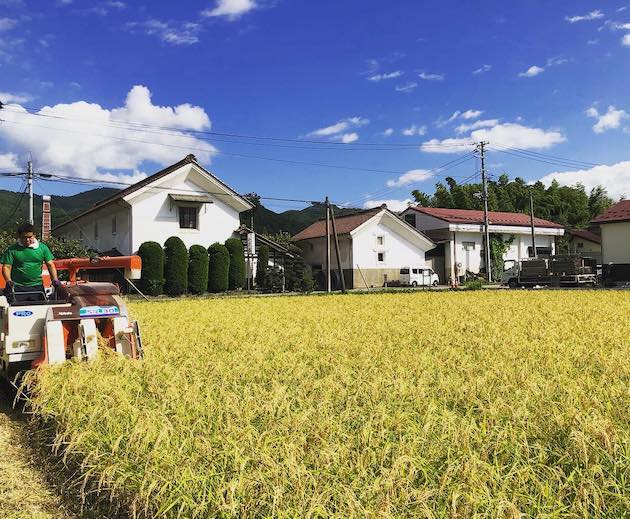
At Takahashi Shosaku Brewery, rice is sourced not only from local contract farmers but also cultivated in-house. Their own fields span four hectares—roughly equivalent to 0.8 times the size of Tokyo Dome.
“To grow rice is to cultivate the soil. When we think about what is lacking in a field, or how to create better conditions for rice to grow, conventional farming typically involves adding missing nutrients, eliminating unwanted elements with pesticides, or applying treatments to restore weakened crops.
Organic farming, on the other hand, is about asking how we can create an environment where healthy rice can grow using only what already exists here.”
In their own fields, the brewery cultivates rice under both “special cultivation” standards and JAS-certified organic standards. Yields are lower compared to conventional methods: about 9–10 bales per tan (≈10 ares) for special cultivation, and 6–8 bales for organic JAS-certified rice.
At the same time, Takahashi is clear that organic cultivation does not directly translate into specific flavor or aroma characteristics in the final sake.
“There isn’t a direct correlation like ‘organic rice produces this aroma or this flavor.’ However, when brewing with organic rice, there is a very clear tendency: the moromi becomes stronger.
To guide fermentation in the direction we want, we need to carefully prepare the environment. With organic rice, once the right conditions are in place, the moromi will reliably progress as intended all the way through.
Take Gohyakumangoku, for example. It’s an early-ripening variety, so it’s often approached from the perspective of preventing deterioration during aging rather than encouraging maturation. But when grown organically, its fermentation power becomes more vigorous, resulting in a sake that matures more gently.”
While Takahashi explains the relationship between rice and sake in clear, technical terms, he is equally committed to expressing the character of Aizu—the land itself—through his sake.
Even his approach to organic farming reflects this perspective. “Thinking about how to optimize fertilizers, water, and the overall environment based on the natural conditions of this land—that process itself is incredibly interesting,” he says. In this sense, organic cultivation is not an end in itself, but a means of drawing out the unique qualities of Aizu.
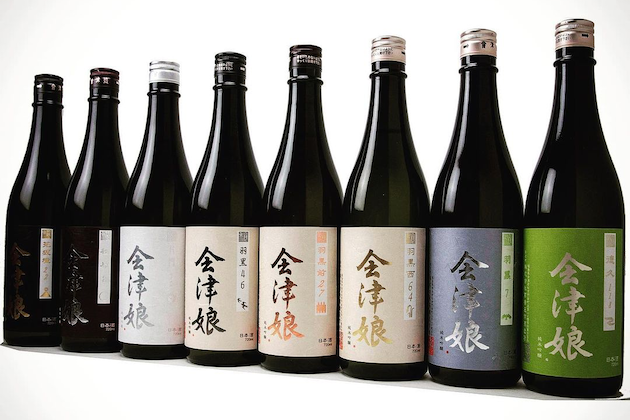
This pursuit of terroir has taken a further step forward. Since 2019, the brewery has embarked on an initiative called “Ichi Den Ichi Jo” (one field, one brew), in which a single sake is produced using rice harvested from a single, specific rice field.
Gratitude and Human Connections Behind Dosan Doho
Long before it became common for breweries to engage in rice cultivation and translate it into added value, Takahashi had already been exploring and evolving sake brewing based on dosan doho. When speaking about the path he has taken in forging this new direction, he consistently emphasizes his deep sense of gratitude toward the many people around him.
The people I met during my training, the father, who chose to stay grounded and committed to steady work during a time of transition after the high-growth era, the retailers who supported the brewery’s sudden decision to discontinue futsushu, and a university classmate who has worked alongside in both rice cultivation and brewing for over fifteen years—all of these relationships, Takahashi says, have been indispensable to what Takahashi Shosaku Brewery is today.
There is a sense of “quiet intensity, yet gentle umami” in Aizu Musume. Perhaps this is not only a reflection of the land and raw materials of Aizu, shaped through dosan doho, but also an expression of the many human connections and shared commitments that have sustained the brewery over time.
Brewery Information
Takahashi Shosaku Brewery
Address: 755 Higashi, Ichinoseki-mura, Oaza, Kadota-machi, Aizuwakamatsu City, Fukushima Prefecture, Japan
Founded: Around 1868
President & Master Brewer: Wataru Takahashi
Website: https://aizumusume.co.jp/
Pickup Articles


2019.01.18

2019.01.25
Trending Articles


Popular Articles
Recent Articles