2026.06
17
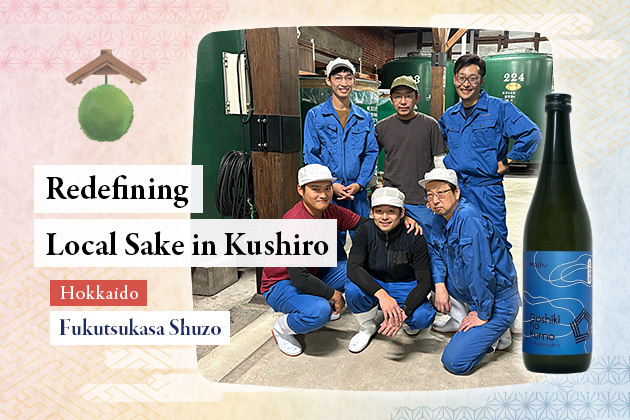
Brewing the Next Century — Fukutsukasa Redefines Local Sake in Kushiro, Hokkaido
Mid-October 2025. Stepping off the plane in Kushiro, the air was already cold, a reminder that in Hokkaido, the seasons turn earlier than on Japan's main island.
Kushiro lies more than four hours east of Sapporo by car, deep in the eastern part of the island. During our visit, Kazuma Yanase, Head of Production at Fukutsukasa Shuzo, generously showed us around the region, guiding us along a route that took in Lake Akan, Lake Mashu, and the stretch from Tsurui to Kushiro City, a journey of more than 200 kilometers. Everywhere we went, someone seemed to know him.
"The sky over Kushiro used to be different," he said, his eyes fixed on the road ahead. "There was always a thin layer of cloud drifting across it, flat and endless. But lately, I've started seeing the kind of towering cumulonimbus clouds you'd expect on the mainland."
Kushiro has long been known for its almost comically mild summers. So what is changing? And amid those changes, what challenges is Fukutsukasa Shuzo, the only sake brewery in Kushiro, now facing?
Kushiro's Only Brewery — and the Steep Road to Mastery
Starting from the Bottom
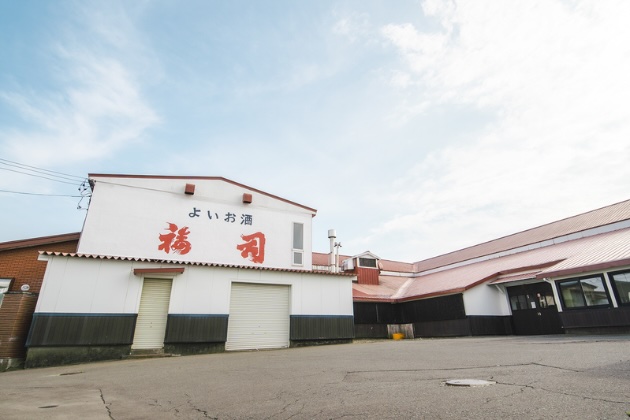
Fukutsukasa Shuzo was founded in 1919, roughly fifty years after settlement began in Hokkaido. The business did not start as a brewery, but as a wholesale distributor, handling sake, soft drinks such as ramune, and a range of food products. The shift into brewing came at the suggestion of a trading partner, an Osaka-based sake producer, who put it simply: "Kushiro has cold air and clean water. Why not make your own?" In 1922, the company began brewing at its current site.
Kazuma Yanase spent much of his childhood at his grandparents' home, watching his grandfather, the third-generation owner, and his uncle, now the fourth-generation head of the brewery. By elementary school, he had already made a quiet decision: one day, he would work here.
That decision came sooner than expected. Near the end of his studies at Tokyo University of Agriculture, his grandfather's illness forced the question. His family had reservations. "You haven't seen the outside world yet," they told him. "If you come back now, you won't be of much use." Undeterred, Yanase completed a six-month training program at the Brewing Society of Japan's research institute before joining Fukutsukasa Shuzo in 2006.
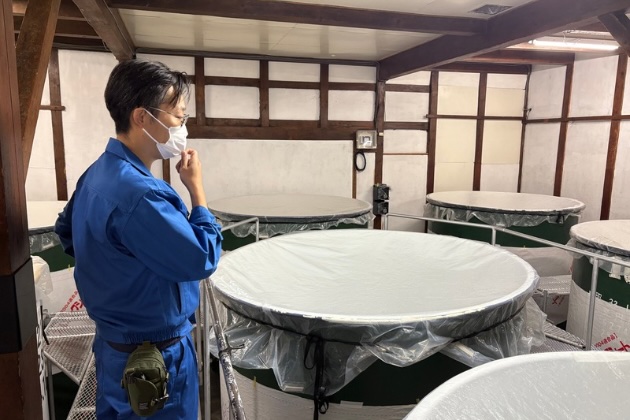
"I started at the very bottom," he recalls. "What we call oimawashi: running errands, handling odd jobs, doing whatever needed to be done. At the time, I still had a student's mindset. I kept trying to weigh in on production decisions, offering ideas about the kind of sake I wanted to make. More than once, I was told to focus on the task in front of me. It didn't sit well with the veteran brewers, and those relationships were strained for a while.
Around my third year, something finally clicked. If I was going to take on a leadership role, I needed to earn the trust of the people around me. After that, I committed myself to the fundamentals: cleaning, preparation, every small task. I made sure I was the one doing them, every time."
Then, in 2010, the situation changed abruptly. The toji and several other staff members resigned, leaving Yanase as the sole remaining member of the production team.
"And at that point, I was still only capable of handling the odd jobs," he says with a wry laugh.
He quickly brought in a colleague from the bottling and delivery side of the business, and the two kept operations going while recruiting new brewers. By 2015, the team had grown to five.
"Everyone except me had zero knowledge of sake brewing. In every sense, we were a team of amateurs."
Recognizing that he could not train an entire team alone, Yanase consulted with the brewery's president and brought in an experienced outside toji. Learning from a veteran while building a cohesive team from the ground up, he gradually shaped what would become Team Fukutsukasa.
No Toji: Brewing as a Team
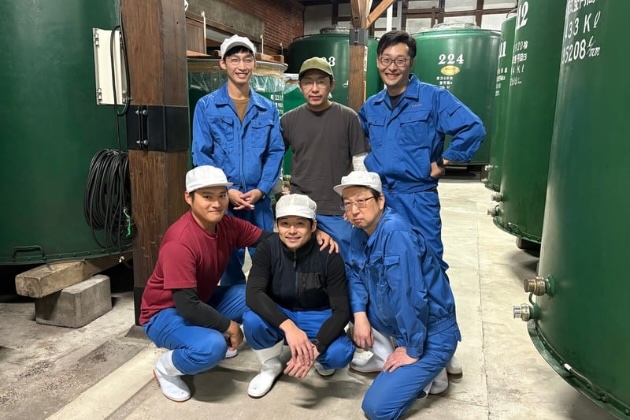
Five years into the new structure, the team had finally found its footing. Then came 2020. As production volumes declined amid the COVID-19 pandemic, the brewery made the decision to stop bringing in outside toji altogether. Yanase stepped up as Head of Production, the title he holds today, assuming full responsibility for output.
The decision to forgo the toji title is deliberate, and Yanase is candid about why.
"The word toji tends to take on a life of its own. Whenever the media covers a brewery, it's always the toji who gets the spotlight, even though everyone else is putting in just as much work. But sake brewing is a collective effort. Since becoming department head, I've tried to make this a place where everyone is recognized."
The team has seen its share of turnover, but has settled into its current configuration of six members. For nearly a decade, Yanase has documented the brewery's day-to-day life on its official blog, 「北海道 釧路の地酒 『福司』 若僧蔵人の醸し屋日記」Hokkaido, Kushiro Local Sake ‘Fukutsukasa’—A Young Brewer’s Fermentation Diary. The entries introduce team members by affectionate nicknames. Yanase himself goes by Kamoshiya, "the fermenter."
All six are from Hokkaido, and more than a few found their way to Fukutsukasa through the same entry point: Yanase's blog.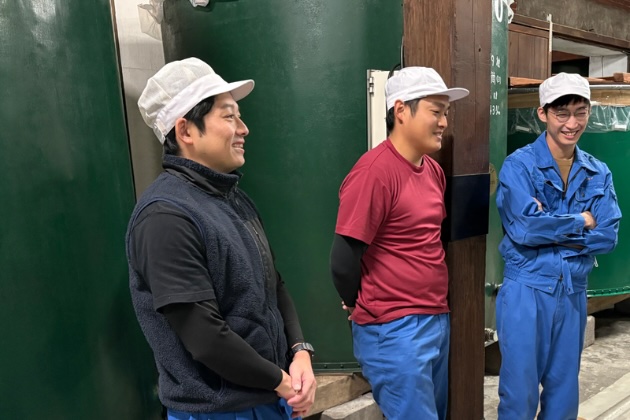
Nanoii is in his second year at the brewery, having transitioned from a sales role at a trading company. Drawn to Fukutsukasa's values, he wanted, in his own words, "to be working at a company that contributes to the community by the time my children are grown."
Ace is the son of the fourth-generation owner and Yanase's cousin. "In a department full of introverts," Yanase notes with a smile, "Ace stands out for actually being sociable."
Christopher, the koji specialist, joined straight out of university. Originally trained as a furniture craftsman, he brings that practical skill set to the brewery. He is the person the team relies on for maintenance and repairs.
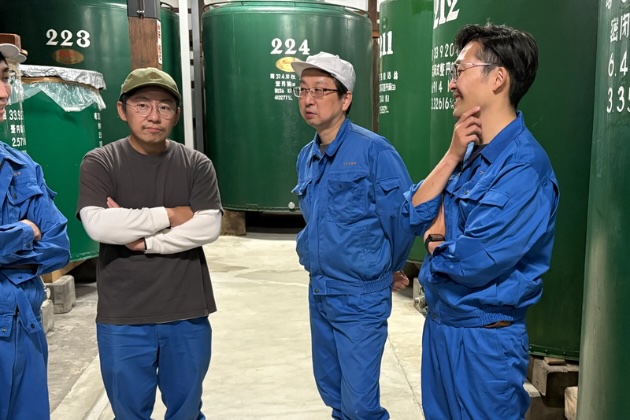
M-Jun is responsible for the moto, or yeast starter. He joined Fukutsukasa in his thirties after working at a car dealership, motivated by a desire to do work he genuinely enjoyed. An avid outdoorsman, he serves as the team's self-appointed expedition leader on foraging trips.
Tsuyoshi oversees analysis and filtration. He was among the first to join the production team when Yanase found himself alone, transferring over from shipping and logistics. In his younger days, he was an avid motorcyclist, and reportedly used to ride a red bike to work.
“If You’re in Kushiro, Drink Fukutsukasa”
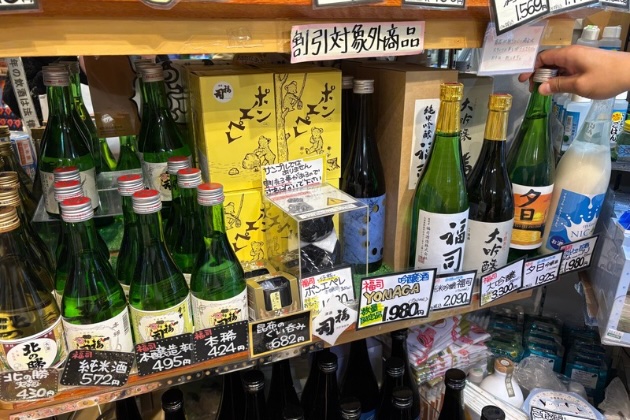
Today, around 90% of Fukutsukasa's production is consumed locally, and the idea that it is Kushiro's sake has become almost self-evident. But this was not always the case. When Yanase first returned to the brewery, it was Kitanokatsu, produced in Nemuro by Usui Katsusaburo Shoten, that dominated the local market.
"People would say outright that Kitanokatsu tasted better than Fukutsukasa. So I started showing up at restaurants, not just to sell, but to build relationships. Local events, dinner parties, wherever I was invited, I went. I kept putting myself out there, building connections."
Gradually, the effort paid off. Restaurant owners began to respond: "That sake you brought last time was excellent," or "I'd like to carry it here." A quiet network of supporters began to take shape.
"Around the time Kushiro's sunsets started gaining recognition as some of the most beautiful in the world, one restaurant created a cocktail called the Yuyake Highball, the 'Sunset Highball.' The owner said, 'If we're putting something local on the menu, it should use a local sake,' and chose Fukutsukasa's dry style. There was also someone who opened a restaurant dedicated to local sake and shellfish, and every location in their group carried Fukutsukasa."
The momentum built steadily. The notion that "if you're in Kushiro, you drink Fukutsukasa" took hold, and production volumes began to rise.
"When I first joined, futsushu, ordinary table sake, accounted for about 80% of our production. That tells you something about how sake is consumed here. Kushiro is a fishing town, and Fukutsukasa is rooted in that culture: sake that doesn't tire the palate, that goes down easily, that you can drink day after day without fatigue. It's an everyday sake, something that belongs on the table alongside local food, night after night."
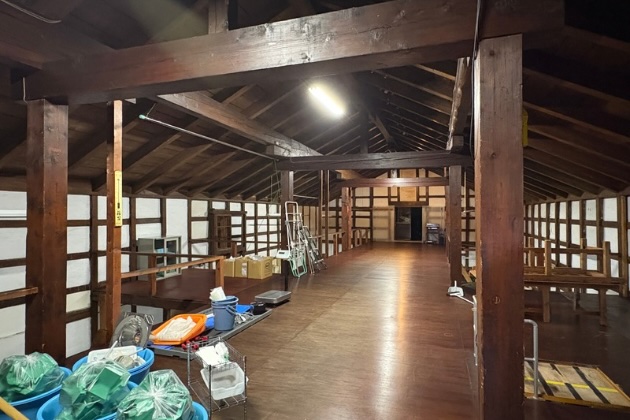
The decision to look beyond Kushiro came largely in response to the disruption caused by the COVID-19 pandemic.
"The production team had always wanted to try new things, but we couldn't get the green light from management. Distribution constraints were part of it as well. Then the pandemic changed the mood: suddenly, there was pressure to innovate or risk falling behind.
It was a difficult period. But it also opened a door. With production volumes down, we finally had the time to focus on individual batches in a way we never had before, tracking outcomes, comparing approaches, and building a real body of data. In that sense, it was an opportunity."
Goshiki no Kumo: A New Brand for the Next Century
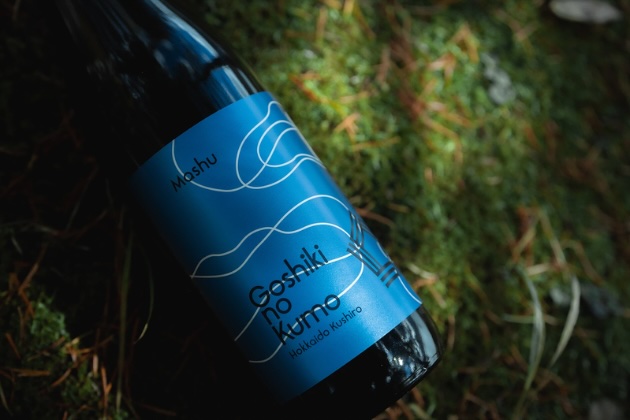
In 2023, Fukutsukasa launched a new label: Goshiki no Kumo, or "five-colored clouds."
"When we began thinking about expanding beyond Kushiro, the first question was: what does Fukutsukasa have that no one else does? Breweries in Hokkaido are relatively young. We can't compete with the centuries of history found on the mainland. But I started to wonder whether what seems like a disadvantage there might actually work in our favor here."
One example Yanase points to is climate change. Yamadanishiki, Japan's most prized sake rice, was once impossible to cultivate in Hokkaido. That is beginning to change.
"Hokkaido has long been known for its raw ingredients: potatoes, onions, seafood, exceptional products that speak for themselves. But places like Tokyo, Kyoto, and Osaka moved beyond that long ago. They took great ingredients and asked: how do we transform them? How do we add value? That's how those food cultures were built.
Perhaps Hokkaido has been sustained by the strength of its ingredients alone, and is only now entering a new phase: one defined by craft and intention. If so, what appears to be disruption may, in fact, be an opening."
Goshiki no Kumo currently comprises four expressions, each framed around a distinct brewing question.
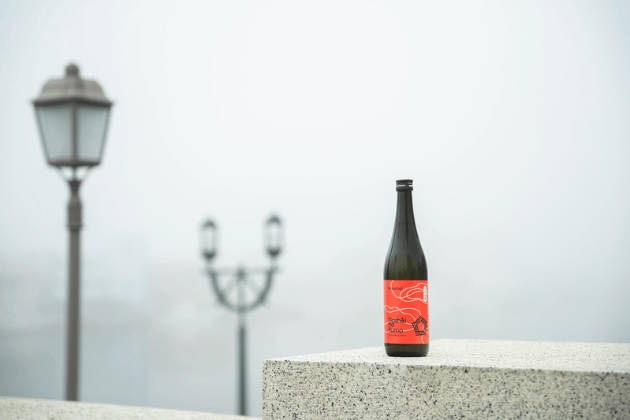
Nusamai is brewed with Ginpu, a sake rice developed for Hokkaido's climate, and asks: how can the full potential of local rice be realized as it continues to evolve under changing conditions?
Mashu takes a different approach. Made with Yamadanishiki, it reflects the view that greater flexibility in ingredient selection may be necessary in the years ahead.
Ashiri looks toward the future of flavor, using white koji, a technique more commonly associated with shochu, to explore new aromatic possibilities in sake.
Jiri addresses the challenge of low-alcohol brewing, responding to growing demand for lighter styles both in Japan and abroad.
"Because the name means 'five colors,' people often ask whether there are five expressions," Yanase says with a smile. "The fifth is still in development. We're planning to explore lactic acid bacteria, specifically the roles they might play in sake fermentation. That will require careful strain selection, so it will take time."
A Changing Kushiro: The Role of Local Sake
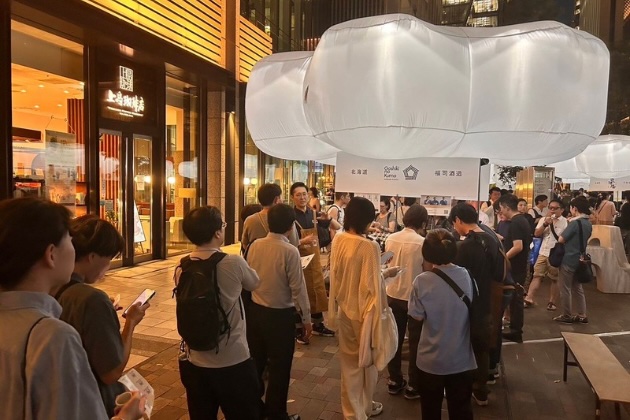
Breaking into the Tokyo market opened up a new dimension for Fukutsukasa: access to feedback from restaurants and consumers far beyond their usual orbit.
"In a sense, we had been frogs in a well. But when people in Tokyo, at restaurants and sake shops, started telling us the sake was good, something shifted. There were times I wondered whether we had already fallen out of step with the times. Hearing that response made me feel we were still part of the same conversation."
At the same time, Yanase is candid about his view of the market. "From where I stand as a brewer, the flavor profiles that drive popularity in sake have already run their course. The wave has passed." Rather than chasing trends, Fukutsukasa's approach through Goshiki no Kumo is to explore what might come next.
"What I've become most aware of lately, living in Kushiro, is just how much the climate has changed. Summers are genuinely hot now. There are days when you can't do without air conditioning, in Kushiro, of all places. It still surprises me.
The sea has changed as well. Sanma (pacific saury) used to be so abundant that neighbors would show up at your door with more than they could use. Now it's considered a luxury fish. Things we once had in excess have become too expensive to buy."
During our visit, we passed through parts of the Kushiro Wetlands where large-scale solar developments have become a source of controversy. Against this backdrop, Yanase keeps returning to a simple question: what should our sake be in a place undergoing this much change?
"I don't think the goal should simply be for the brewery to survive. What matters is remaining necessary. If local ingredients change, we revisit our methods and our concepts. If the needs of the community shift, we shift with them. That kind of steady, patient adaptation, that, to me, is what it means to be a local sake."
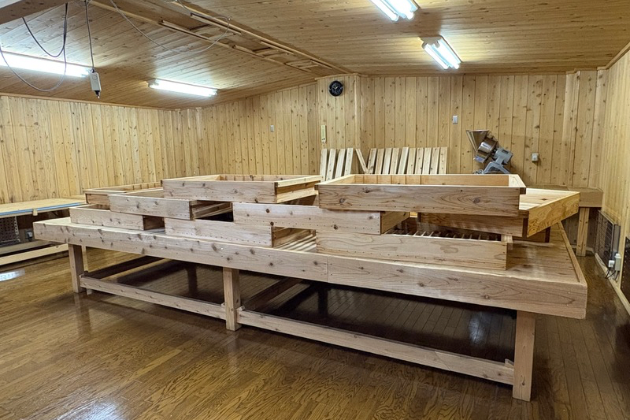
Fukutsukasa exists as part of Kushiro, shaped by the same landscape, the same waters, the same rhythms. When its sake appears at a shop or event in Tokyo, it carries something of that place with it, acting as a kind of messenger from a distant and distinctive corner of Japan.
"Ideally, I want people to wonder: why does Fukutsukasa taste like this? Being told something is delicious is always gratifying. But what I really want is for this sake to exist as something inseparable from Kushiro, as a taste that could only have come from this place. That sense of terroir, if you will, is what Fukutsukasa is about.
At the same time, I know that alone isn't enough to sustain us. That's why we need something like Goshiki no Kumo, new ideas, new approaches, the capacity to adapt. The craft and imagination to meet the next era, whatever it may be."
Not simply drawing on nature's gifts, but listening closely to a shifting environment, and brewing with the next hundred years in mind. That orientation may be what makes Fukutsukasa Shuzo such a fitting reflection of Kushiro as it exists today.
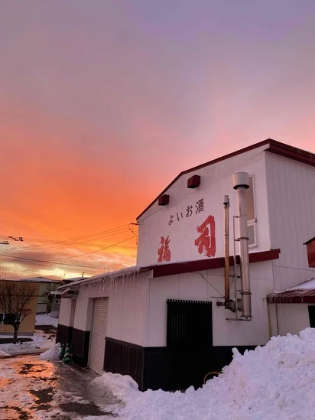
Brewery Information
Fukutsukasa Shuzo
Address: 2-13-23 Sumiyoshi, Kushiro, Hokkaido, Japan
Phone: +81-154-41-3100
Founded: 1919
President: Yukihiro Yanase
Head of Production: Kazuma Yanase
Brewery Website: https://www.fukutsukasa.jp/
“Goshiki no Kumo” Brand Website: https://goshiki-no-kumo.com/
Pickup Articles


2019.01.18

2019.01.25
Trending Articles


Popular Articles
Recent Articles