2026.07
08
How To Read a Sake Label: A Guide to What's on the Bottle
When you first become interested in sake and visit a specialty shop, the label is often the first challenge. Unfamiliar characters and technical terms can feel overwhelming before you even begin exploring the selection.
This article explains the key information found on a sake label and what it means. Once you understand what each element tells you, you can begin to form a rough idea of a sake’s character and flavor profile before opening the bottle—making the process of choosing sake much more enjoyable.
Labeling regulations vary by country, and producers or importers may adjust labels depending on the market. This article focuses on labeling standards in Japan, providing foundational knowledge that applies broadly wherever you encounter sake.
Required Information
We begin with the information required by Japanese law. Alongside these mandatory elements, we also briefly explain what cannot appear on a sake label.
Nihonshu (Japanese sake) or Seishu (sake)
Under Japan’s Liquor Tax Act, sake is legally categorized as seishu (清酒). Labels must display either nihonshu (日本酒, Japanese sake) or seishu (清酒, sake).
Under Japanese regulations, the term nihonshu may only be used for seishu made from Japanese-grown rice and produced in Japan. The broader legal category, seishu, is defined as:
- A beverage produced by fermenting rice, rice koji, and water, then filtering the resulting liquid.
- A beverage produced by fermenting rice, water, sake lees, rice koji, and/or other ingredients specified by government ordinance, then filtering the resulting liquid. The total amount of these additional ingredients must not exceed the weight of the rice used.
In practice, products made outside Japan, or products made with imported rice, are generally labeled seishu rather than nihonshu. However, some products that meet the requirements for nihonshu may still choose to display seishu on the label.
It is also worth noting that doburoku (unfiltered sake) is not classified as seishu under Japanese law because it has not undergone filtration. Instead, it falls under the category of “other brewed alcoholic beverages.” Products containing additional flavoring ingredients such as fruit juice or extracts are classified as liqueurs.
Alcohol Content
Sake must have an alcohol content below 22%. Labels may indicate alcohol content with a margin of ±1%.
For example, a sake with an actual alcohol content of 15.6% may be labeled as:
- 15%
- 15% to under 16%
- 16%
Undiluted sake (genshu) generally has an alcohol content of around 18-20%, while most sake is diluted with water after fermentation to approximately 15-16% before shipment.
Alcohol content can also serve as a rough guide to a sake’s body. Lower-alcohol sake (around 13%) tends to feel lighter on the palate—unless it is notably sweet—while sake around 17% generally feels fuller and more substantial. This makes alcohol content useful beyond simply indicating strength.
Ingredients
Ingredients are listed in descending order by volume, excluding water.
For example, sake made only from Japanese-grown rice and rice koji may be labeled:
Ingredients: Rice (domestic), Rice Koji (domestic rice)
The indication of rice origin, such as “domestic” or “domestic rice,” is required under Japan’s Rice Traceability Act. More specific regional descriptions, such as “Aizu-grown,” may also be used when they refer to recognized place names.
Listing the specific rice variety is optional. It may only be displayed when the variety is officially recognized and accounts for more than 50% of the rice used.
Some sake contains jozo alcohol (brewers’ alcohol), which may be added to adjust aroma, flavor, or fermentation characteristics. In some cases, sugars, acidulants, or amino acids may also be added. Yeast and enzyme preparations do not need to be listed as ingredients.
Date of Production
The production date is displayed using either the Western or Japanese calendar.
Despite the wording, the “date of production” does not indicate the date when the sake was brewed. In most cases, it refers to the date the sake was bottled.
For tokutei meishoshu (specially designated sake) that has been bottle-aged, the date may refer to when the label was applied in preparation for shipment.
What May Not Appear on the Label
Just as certain information is required, some expressions are prohibited.
Claims such as “the finest” or “number one,” which suggest that a product has the highest quality or production standards in the industry, are not allowed. Statements such as “official supplier to government agencies” are also prohibited.
However, terms such as “superior” or “excellent” may be used in limited circumstances when the claim applies only within a producer’s own product range and can be supported by objective evidence.
Optional Information
Beyond legally required information, breweries may include additional details at their discretion.
Tokutei Meishoshu (Specially Designated Sake)
Tokutei meishoshu refers to categories such as junmai-shu, ginjo-shu, and honjozo-shu.
These classifications are determined mainly by whether brewers’ alcohol has been added and by the polishing ratio of the rice.
Sake labeled junmai contains no added brewers’ alcohol. When added brewers’ alcohol does not exceed 10% of the weight of polished rice, the sake may qualify for categories such as ginjo or honjozo.
| Designation | Ingredients | Polishing Ratio | Ginjo Brewing |
|---|---|---|---|
| Junmai | Rice, Rice Koji | No requirement | — |
| Tokubetsu Junmai | Rice, Rice Koji | 60% or below, or special brewing method | — |
| Junmai Ginjo | Rice, Rice Koji | 60% or below | Yes |
| Junmai Daiginjo | Rice, Rice Koji | 50% or below | Yes |
| Honjozo | Rice, Rice Koji, Brewers' Alcohol | 70% or below | — |
| Tokubetsu Honjozo | Rice, Rice Koji, Brewers' Alcohol | 60% or below, or special brewing method | — |
| Ginjo | Rice, Rice Koji, Brewers' Alcohol | 60% or below | Yes |
| Daiginjo | Rice, Rice Koji, Brewers' Alcohol | 50% or below | Yes |
Generally, a higher polishing ratio (meaning more of the rice remains) tends to produce a richer, more rice-forward flavor, while a lower polishing ratio (meaning more of the outer layers are removed) often results in a cleaner and more refined profile.
Ginjo-style brewing techniques, including junmai ginjo-shu and junmai daiginjo-shu, are known for producing elegant fruity and floral aromas.
SMV, Acidity, and Amino Acid Content
Sake Meter Value (SMV), acidity, and amino acid content are numerical indicators that can provide clues about a sake’s flavor profile.
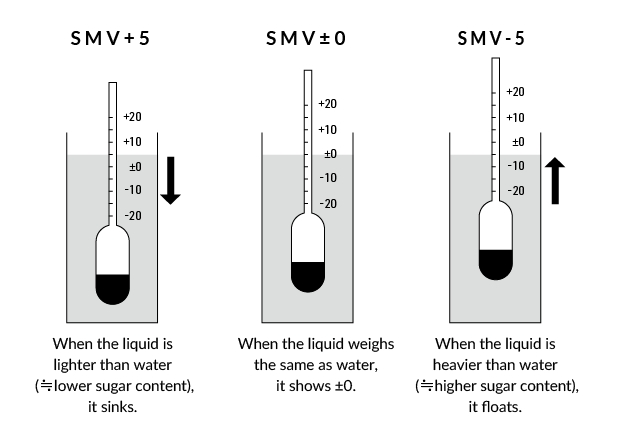
SMV indicates the specific gravity of sake compared with water and is often used as a rough reference for perceived sweetness and dryness. A value of zero means the sake has approximately the same density as water. Negative values indicate higher density, while positive values indicate lower density.
Because sugar is heavier than water and alcohol is lighter, sake with more residual sugar tends to have a lower (negative) SMV, while sake with higher alcohol levels tends to have a higher (positive) SMV.
SMV and residual sugar also offer clues about a sake’s density and body. Because sweeter sake retains more residual sugar, it generally has a fuller body, whereas dry sake tends to feel lighter and crisper.
Acidity represents the total amount of organic acids in sake. Higher acidity generally contributes to a sharper, more pronounced taste, while lower acidity tends to create a softer impression.
Amino acid content indicates the amount of amino acids present in sake. Amino acids contribute to umami, with glutamic acid being one well-known example. Higher amino acid levels often correspond to a richer, more savory character.
When these indicators appear on a label, they provide useful hints about the sake’s likely style.
BY (Brewery Year)
“BY” stands for Brewery Year and indicates the brewing year in which the sake was produced.
Unlike the Japanese fiscal year (April–March), the sake brewing year runs from July 1 to June 30 of the following year.
Traditionally, brewing years were expressed using the Japanese era calendar, such as “30BY” for the 30th year of the Heisei era. However, after the transition to the Reiwa era, potential confusion arose because labels such as “1BY” could refer to different eras. As a result, Western calendar notation, such as “2019BY,” has become more common.
Other Optional Terms
Additional terms may appear on labels depending on the product:
- Genshu: Undiluted sake with no water added after production. Generally higher in alcohol and more concentrated in flavor.
- Nama (-zake): Sake that has not undergone any heat treatment (hi-ire). Known for its fresh and vibrant character.
- Shizuku (-dori): Sake collected by letting the moromi drip naturally from a hanging bag without applying pressure. Prized for its especially clean and delicate character.
- Nama-zume / Nama-chozo: Sake that has undergone only one pasteurization step. These styles retain characteristics closer to unpasteurized sake compared with standard twice-pasteurized sake.
- Ki-ippon: Junmai sake produced entirely at a single brewery.
- Taru-zake: Sake aged in wooden casks, acquiring aromas from the wood.
- Muroka: Sake that has not undergone charcoal filtration after pressing, retaining more of its original character.
- Yeast starter type: Terms such as yamahai, kimoto, and bodaimoto indicate the method used to prepare the yeast starter and can influence flavor characteristics.
- Yeast variety: The yeast strain used during fermentation affects aroma and acidity.
Other information that may occasionally appear includes the toji guild affiliation, fermentation period of the moromi (main mash), and the percentage of koji rice used.
Summary
A sake label contains a wide range of information, divided into legally required details and optional information provided by the brewery.
Together, these elements serve two purposes: ensuring accurate product information for consumers and expressing the individuality and character of each sake.
The next time you find a sake you enjoy, take a closer look at the label. The information written there may deepen your understanding and guide you toward your next discovery.
Pickup Articles


2019.01.18

2019.01.25
Trending Articles


Popular Articles
Recent Articles