2025.12
02
What Makes a Sake Truly Dry? - “Complete Fermentation” and the Technique Behind It
Fermentation refers to the process by which microorganisms transform food in ways that are beneficial to humans. In sake brewing, fermentation is driven by the activity of koji mold and yeast, leading not only to the production of sugars and alcohol, but also playing a decisive role in shaping aroma and flavor.
Within this context, there is a concept known as “complete fermentation (kanzen hakko).” While the term may not be widely familiar, it offers an important perspective on how fermentation is understood and pursued in sake brewing.
In this article, we take a closer look at what complete fermentation means, the characteristics of sake brewed with this approach, and the key considerations involved in its production.
What is Complete Fermentation?
Let us begin by looking at the basic fermentation process that underpins sake brewing.
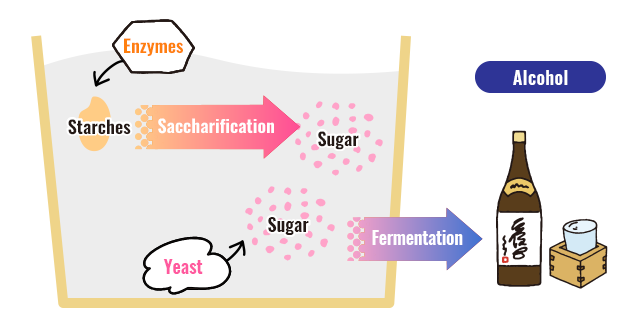
Rice, the primary raw material for sake, does not naturally contain glucose, which is required for alcoholic fermentation. For this reason, the starch in the rice must first be broken down into glucose through the action of koji mold. Yeast then metabolizes this glucose, producing alcohol and carbon dioxide.
In sake brewing, this conversion of starch into sugar (saccharification) by rice koji and the alcoholic fermentation carried out by yeast take place simultaneously within the same tank. Because these two processes proceed in parallel, sake’s fermentation system is known as multiple parallel fermentation.
For a more detailed explanation of multiple parallel fermentation, see the related article:Defining Complete Fermentation
In most cases of sake brewing, some amount of sugar remains in the moromi (main mash), and the brewing process moves on to the pressing stage while the yeast is still active. Complete fermentation, by contrast, refers to pushing alcoholic fermentation as far as possible, until nearly all fermentable sugars—excluding those that yeast cannot metabolize—have been broken down.
An important point to keep in mind is that complete fermentation does not mean that all sugar disappears from the moromi. In sake’s multiple parallel fermentation, saccharification by koji mold proceeds alongside alcoholic fermentation by yeast. If saccharification does not progress sufficiently, fermentation may come to a halt once available sugars are depleted, even though some of the rice itself has not fully dissolved. In such cases, the resulting sake lees still contain starch that could, in principle, be converted into sugar.
When fermentation is carried through to the point where little rice or starch—the raw material for sugar—remains available, the amount of sake lees decreases, and very little rice, starch, or sugar is left behind in the lees. Seen from this ideal perspective, complete fermentation can be understood as a state in which the raw materials of fermentation—rice and sugars—are reduced to the bare minimum.
Characteristics of Complete Fermented Sake
One of the defining characteristics of fully fermented sake is its relatively high alcohol content and a high Sake Meter Value (Note 1). When yeast remains highly active and continues to break down glucose, the amount of alcohol produced naturally increases. At the same time, because fermentable sugars have been largely consumed, the resulting sake tends to show a higher SMV, placing it firmly in the category of what is commonly described as dry sake.
Note 1: Sake Meter Value (SMV) is a numerical indicator commonly used to describe a sake’s perceived sweetness or dryness. It is calculated by measuring specific gravity, which reflects both the progress of alcoholic fermentation and the degree to which sugars have been metabolized.
For a more detailed explanation of SMV, see the related article:Another notable characteristic of complete fermented sake is its relatively high amino acid content, which contributes to a deep, umami-driven flavor profile. In brewing sake with complete fermentation in mind, brewers typically employ koji with strong saccharifying power in order to dissolve the rice as thoroughly as possible.
As starch-degrading enzymes are produced during koji making, protein-degrading enzymes are released alongside them. These enzymes break down proteins in the rice, generating amino acids in the process and leading to a higher amino acid level in the finished sake. In addition, as fermentation reaches its final stages and yeast cells begin to die, amino acids contained within the yeast are released into the mash.
At the same time, compounds such as sulfur-based components are also liberated, which is why complete fermented sake often develops a more complex and layered aromatic profile.
As we have seen, fully fermented sake tends to contain a high concentration of amino acids while retaining very little residual sugar. As a result, depending on the label, some examples may even convey a subtle saline impression on the palate—an expression that reflects both the depth and the sharpness characteristic of this style.
Techniques for Brewing Complete Fermented Sake

Complete fermented sake is known for its appealing balance: rich umami and fullness on the palate, paired with a clean, decisive finish.
What, then, is required to carry fermentation through to this point? In the following section, we consider the key technical factors brewers must pay attention to in order to achieve complete fermentation.
Using Koji That Fully Dissolves the Rice
To bring fermentation to a state where as little rice and fermentable material remains as possible, the starch in the rice must be thoroughly broken down into glucose by the action of koji. This requires koji enzymes to remain active through the final stages of fermentation.
When aiming for complete fermentation, it is essential to use rice koji with strong saccharifying power—rich in α-amylase, the enzyme responsible for breaking down starch—and capable of dissolving the rice thoroughly. For this reason, brewers generally favor so-haze koji, in which the mold hyphae spread evenly throughout the entire grain of steamed rice.
Koji also serves as an important source of nutrients, including vitamins necessary for yeast growth. Increasing the koji ratio (koji-buai) therefore promotes more vigorous fermentation overall.
Note 2: Koji-buai refers to the proportion of koji rice relative to the total weight of rice used from the yeast starter through the final addition.
Cultivating Yeast with High Alcohol Tolerance
Because complete fermentation results in higher alcohol levels, it is essential to use yeast strains with strong alcohol tolerance.
Yeast strains that produce highly aromatic profiles—such as those known for elevated ester production—tend to have relatively weaker fermentation power. These yeasts often begin to slow or stop fermentation once alcohol levels reach the high 16% range, and many are unable to survive once concentrations approach 18%, succumbing to the stress of high alcohol content. When this occurs, sugars remaining in the moromi cannot be fully metabolized, making complete fermentation difficult to achieve.
By contrast, yeast strains with high alcohol tolerance are able to withstand elevated ethanol levels without dying off prematurely, allowing them to continue breaking down sugars until the final stages of fermentation.
Among widely distributed yeast strains, Kyokai Yeast Nos. 7, 9, and 11 are known for their strong fermentation capacity and are generally considered well suited to sake brewed to full or near-complete fermentation.
In addition, traditional yeast starter methods such as kimoto and yamahai (kimoto-based starters) are often regarded as advantageous for complete fermentation. In kimoto-style brewing, lactic acid bacteria are allowed to proliferate naturally, and the lactic acid they produce suppresses unwanted microorganisms. Compared with sokujo-moto—where food-grade lactic acid is added directly—this approach involves a wider range of microbial activity.
As a result, the yeast cultivated in kimoto-based starters is believed to develop stronger cell walls, higher survival rates even under elevated temperatures exceeding 30°C, and greater tolerance to high alcohol concentrations.
Managing the Moromi Under Optimal Fermentation Conditions
In conventional sake brewing, the maximum temperature of the moromi is carefully adjusted to achieve the desired style of sake. For futsushu, this peak temperature is typically set at around 15°C, while for premium designated sakes it is usually kept lower, at approximately 10–12°C. These temperature ranges are chosen to balance saccharification and alcoholic fermentation in line with the intended flavor profile.
When the goal is complete fermentation, however, the priority shifts to minimizing the remaining starch and sugar in the moromi as much as possible. If the temperature is too low, yeast activity and proliferation are suppressed, preventing the yeast from fully consuming the available sugars. Conversely, if the temperature is too high, the pace of alcoholic fermentation can outstrip the saccharification activity of the koji. In such cases, starch remains insufficiently broken down, and the yeast—deprived of an adequate nutrient supply—enters a dormant state before ultimately dying off.
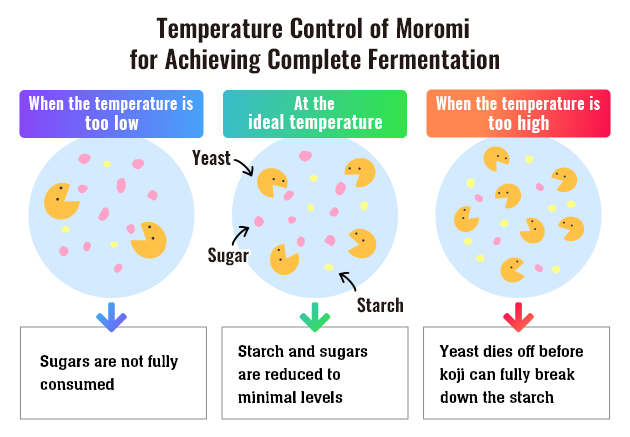
In principle, it is possible to produce sake that undergoes complete fermentation if temperature is controlled so that saccharification and alcoholic fermentation proceed at the same rate. In reality, however, achieving this level of control is extremely difficult.
While it cannot be generalized in all cases, allowing fermentation to proceed at a slightly higher temperature after tomezoe—the third and final stage of sandan-jikomi—often results in vigorous saccharification and fermentation during the first half of moromi. In the latter half, lowering the temperature and continuing fermentation can lead to a sake with less sake lees and smaller residual amounts of starch and sugar.
Another important factor is oi-mizu, the addition of brewing water after tomezoe. Even yeast strains with high alcohol tolerance will die once the alcohol content exceeds around 20%. To prevent yeast from dying, water must be added at an appropriate timing to reduce the alcohol concentration. However, adding too much water at this stage risks producing a sake with a diluted flavor, making it necessary to carefully judge the amount of water added.
For a more detailed explanation of oi-mizu, see the related article:Supplementing Saccharification Power with Enzyme Preparations
In modern approaches to complete fermentation, there are also methods that rely not on highly aggressive koji alone, but on the supplemental use of enzyme preparations. One example is Gekkeikan’s patented Sugar Super Digest Method, in which branched oligosaccharides—normally difficult to break down and prone to remaining in the moromi—are decomposed by adding α-glucosidase, converting them into forms that yeast can metabolize.
By applying such techniques, it becomes possible to produce sake with zero residual carbohydrates.
Examples of Sake Brewed with Complete Fermentation
Although complete fermentation is not something most drinkers consciously think about, there are breweries that actively pursue this approach in their sake making.
Organic Rice Junmai Sake “Wa no Tsuki 80 Kimoto Genshu”
(Tsukinoi Sake Brewery, Ibaraki Prefecture)
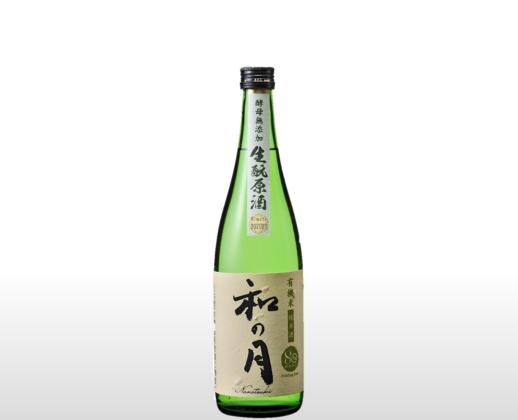
This kimoto-style genshu is brewed by Tsukinoi Sake Brewery in Ibaraki Prefecture, led by master brewer Tatsuya Ishikawa, widely regarded as a leading figure in kimoto brewing. With an alcohol content of 20%, it is made using organic rice polished to 80%, close to brown rice. The sake offers a rich sense of umami and a broad, full-bodied flavor.
Jokigen Junmai Ginjo “Chokara (Super Dry)”
(Sakata Shuzo, Yamagata Prefecture)
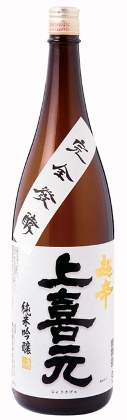
Produced by Sakata Shuzo in Yamagata Prefecture, a brewery known for bringing out the full character of each sake rice variety, this junmai ginjo is brewed to an extreme level of dryness. By fermenting until sweetness is pushed to its absolute limit, the sake achieves a sharply dry profile with a clean, crisp finish. Its refreshing character makes it an excellent match for seafood dishes.
Kimoto no Dobu
(Kubo Honke Brewery, Nara Prefecture)
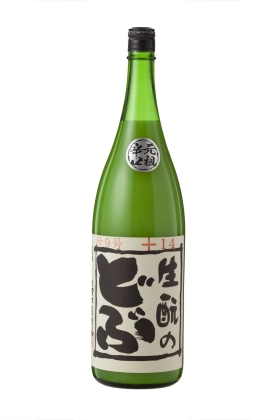
Kubo Honke Brewery, which has been brewing sake for over 300 years in Ouda, Nara Prefecture—often considered the birthplace of sake—produces the popular label Kimoto no Dobu. This is a kimoto-style junmai doburoku brewed through complete fermentation, with a high sake meter value of +14. While rich and full-bodied, it remains distinctly dry, offering a crisp, refreshing finish.
Summary
To pursue complete fermentation and reach a state in which as little fermentable material—such as rice or sugars—as possible remains, careful choices and precise control are required at every stage of the brewing process, from the selection of rice, koji, and yeast to temperature management. Controlling the activity of microorganisms is inherently difficult, and even with today’s advanced technology, producing sake through complete fermentation is far from easy.
That said, the resulting sake—rich in umami yet clean and sharply finished—continues to captivate many dedicated sake drinkers. As the range of sake styles continues to expand, it is possible that sake brewed with complete fermentation will gain wider recognition and come to serve as one of the guiding approaches in future sake production.
References
- Brewing Society of Japan (ed.), Latest Textbook of Sake Brewing, Brewing Society of Japan, 2007.
- Masae Inudo and Hiroko Tsutsumi, “Development of ‘Zero-Carbohydrate’ Sake,” Journal of the Society for Biotechnology, Japan (Japanese edition), Vol. 87, No. 9, 2009.
- Kamoizumi Sake Brewing, “May We Come Visit You? - Tatsuya Ishikawa.”
- Kubo Honke Brewery, “Sake Brewing at Kubo Honke Brewery.”
Pickup Articles


2019.01.18

2019.01.25
Trending Articles


Popular Articles
Recent Articles